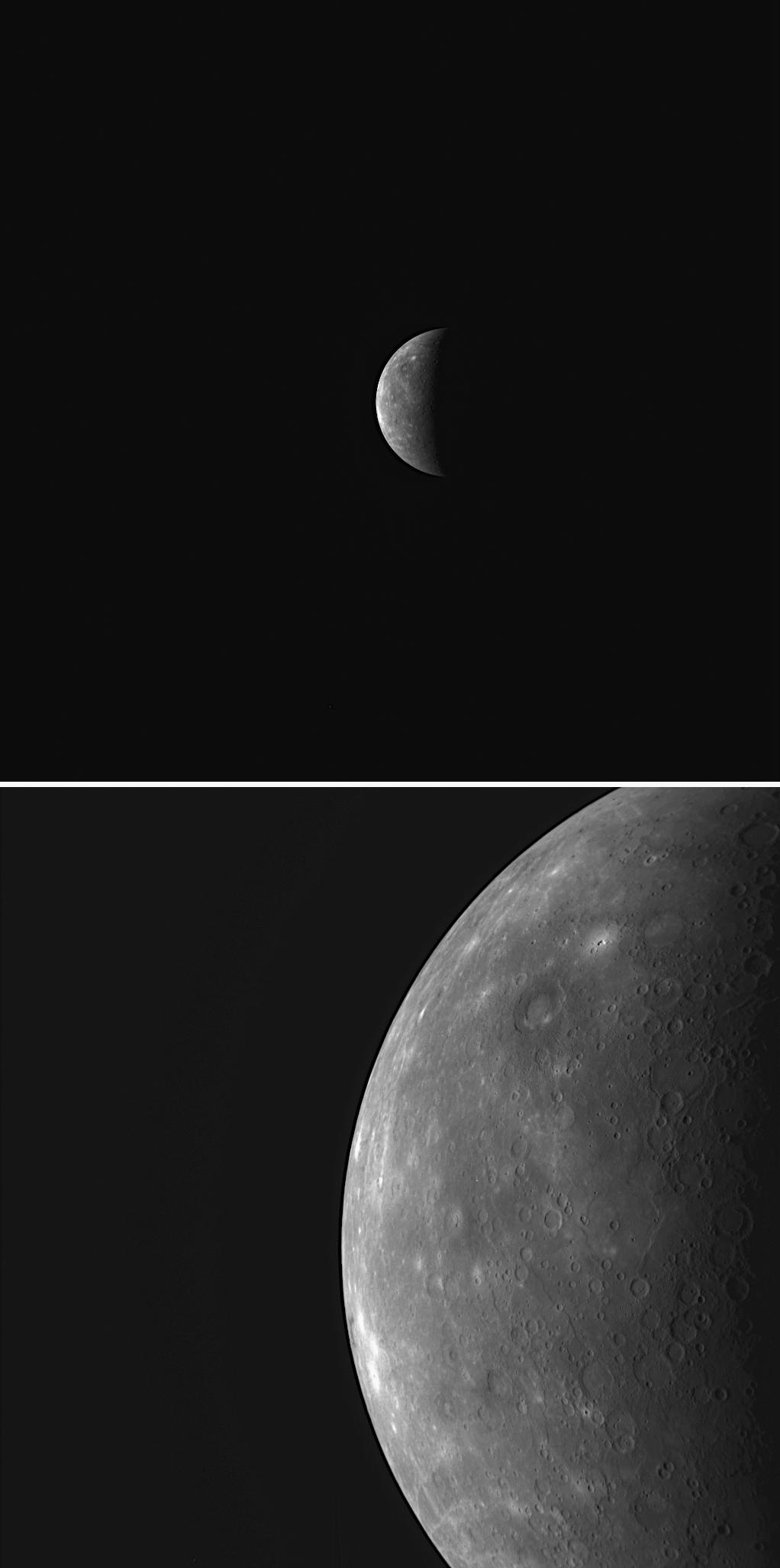
MESSENGER captured these two images of an approaching Mercury just 41 seconds apart. The top image was taken by the WAC, while the bottom image was acquired by the NAC. The dual cameras provide complementary imaging data sets, both valuable for understanding the nature of Mercury's surface. The NAC is higher in resolution than the WAC by a factor of seven and is used to see the details of geologic features. Examples of such geologic features newly discovered in NAC images returned from Mercury flyby 3 include troughs on the floor of a large basin, a pit-floor crater, and an irregularly shaped bright depression. The WAC is equipped with eleven narrow-band color filters, which can be used to createenhanced-color images that highlight differences in the composition ofrocks on Mercury's surface. Enhanced-color images from the first two flybys have been used to map Mercury's crust. Currently, MESSENGER Science Team members are preparing similar enhanced-color views from the WAC images obtained during Mercury flyby 3.
Date Acquired: September 29, 2009
Image Mission Elapsed Time (MET): 162709161, 162709202
Instrument: Narrow Angle Camera (NAC) and Wide Angle Camera (WAC) of the Mercury Dual Imaging System (MDIS)
Resolution: Top WAC image: 24.5 kilometers/pixel (15.2 miles/pixel). Bottom NAC image: 3.5 kilometers/pixel (2.2 miles/pixel).
Scale: Mercury's diameter is 4880 kilometers (3030 miles)
Spacecraft Altitude: 137,000 kilometers (85,000 miles)
These images are from MESSENGER, a NASA Discovery mission to conduct the first orbital study of the innermost planet, Mercury. For information regarding the use of images, see the MESSENGER image use policy.