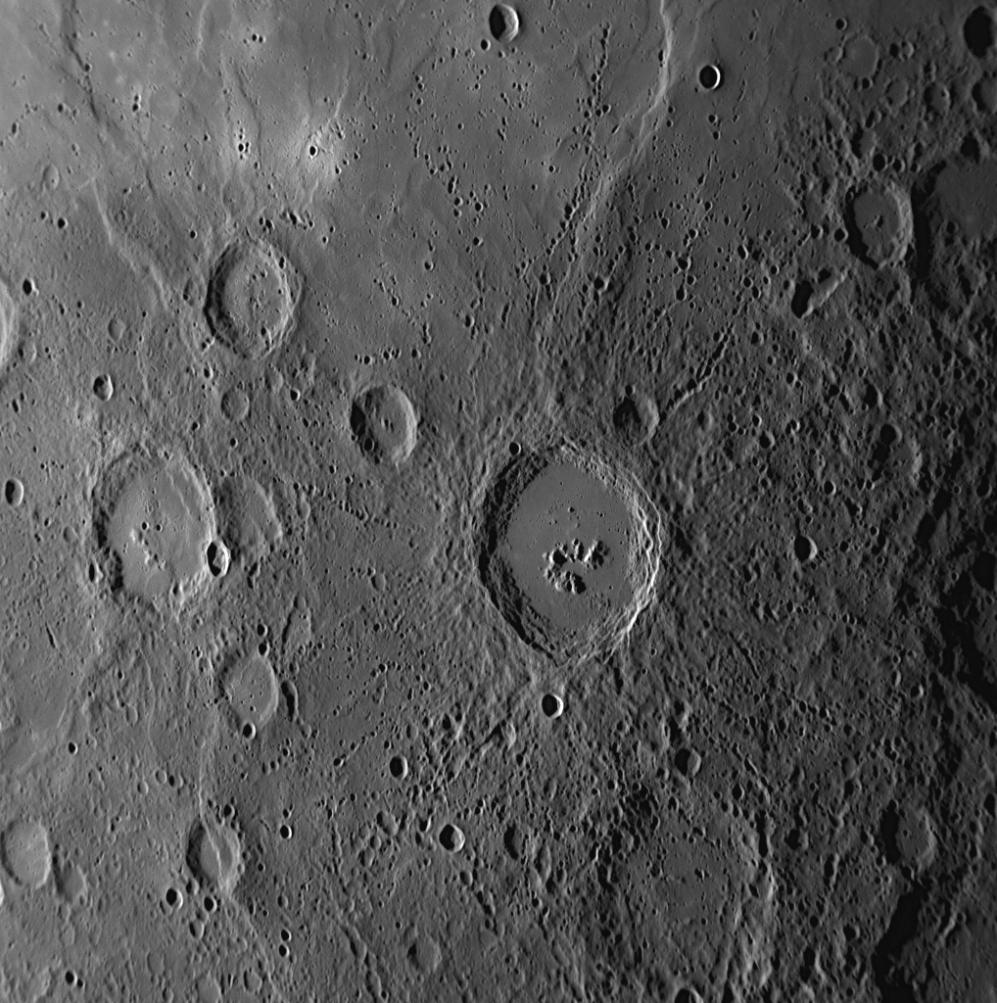
This single NAC image, taken during MESSENGER's third Mercury flyby, captures examples of the multiple processes that have played important roles in shaping the geology of the planet's surface. Impact cratering has clearly been an influential process, and both old degraded craters and relatively young fresh craters can be spotted in this image. Near the center of the image is found a large, fresh crater with a smooth floor, central peak structures, terraced walls, and many associated small secondary craters and crater chains. At the top of the image, smooth plains extend over a large area. Wrinkle ridges are visible on the plains. Smooth plains are widespread on Mercury's surface, and there is evidence that many of the smooth plains are volcanic in origin. In the lower left of this image, a scarp (cliff) can be seen cutting through a deformed impact crater. Numerous examples of similar relationships between scarps and craters have been identified on Mercury's surface. It is thought that such scarps are the surface expressions of large faults that formed in Mercury's past as the planet's interior cooled and the surface consequently contracted slightly. MESSENGER Science Team members are studying images like this one to decipher the story of Mercury's geology and its many different chapters.
Date Acquired: September 29, 2009
Image Mission Elapsed Time (MET): 162744236
Instrument: Narrow Angle Camera (NAC) of the Mercury Dual Imaging System (MDIS)
Resolution: 400 meters/pixel (0.25 miles/pixel)
Scale: This image is about 410 kilometers (250 miles) across
Spacecraft Altitude: 15,300 kilometers (9,500 miles)
These images are from MESSENGER, a NASA Discovery mission to conduct the first orbital study of the innermost planet, Mercury. For information regarding the use of images, see the MESSENGER image use policy