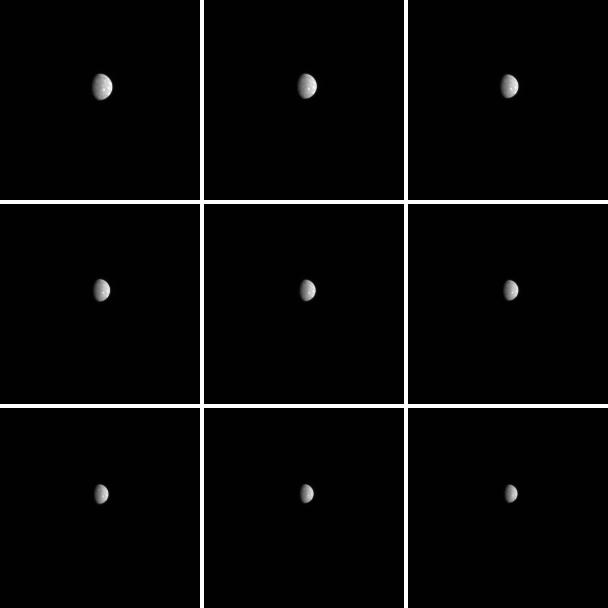
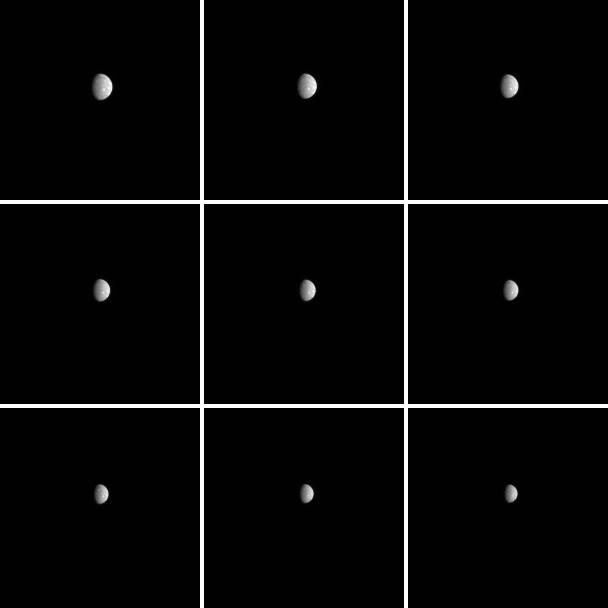
MESSENGER's closest approach to Mercury occurred over a week ago, yet observations of the Solar System's innermost planet continue. Shown here are just nine images of the 1,177 planned with the goal of characterizing how the measured brightness of Mercury's surface is controlled by changing lighting conditions. As MESSENGER approached and departed the planet during the mission's third Mercury flyby, the angle between the Sun, Mercury's surface, and the spacecraft was continually changing. This angle is called the phase angle. By collecting images that show the full planet over a large range of phase angles, the effect of the phase angle on Mercury's apparent brightness can be determined. Observations are made in all 11 narrow-band WAC filters to gain information about how this effect varies with wavelength (color of light). Such information is very important when trying to compare and interpret images of Mercury's surface that were collected under different lighting conditions. This large phase-angle imaging campaign began September 22, more than a week before the spacecraft's closest approach to Mercury, and will continue until October 20.
Date Acquired: October 3 - 4, 2009
Image Mission Elapsed Time (MET): 163047589, 163063489, 163081789, 163100689, 163115989, 163133089, 163149589, 163167589, 163185589
Instrument: Wide Angle Camera (NAC) of the Mercury Dual Imaging System (MDIS)
WAC Filter: 7 (750 nanometers)
Scale: Mercury's diameter is 4880 kilometers (3030 miles)
Spacecraft Altitude: 1,030,000-1,500,000 kilometers (640,000-930,000 miles)
These images are from MESSENGER, a NASA Discovery mission to conduct the first orbital study of the innermost planet, Mercury. For information regarding the use of images, see the MESSENGER image use policy.