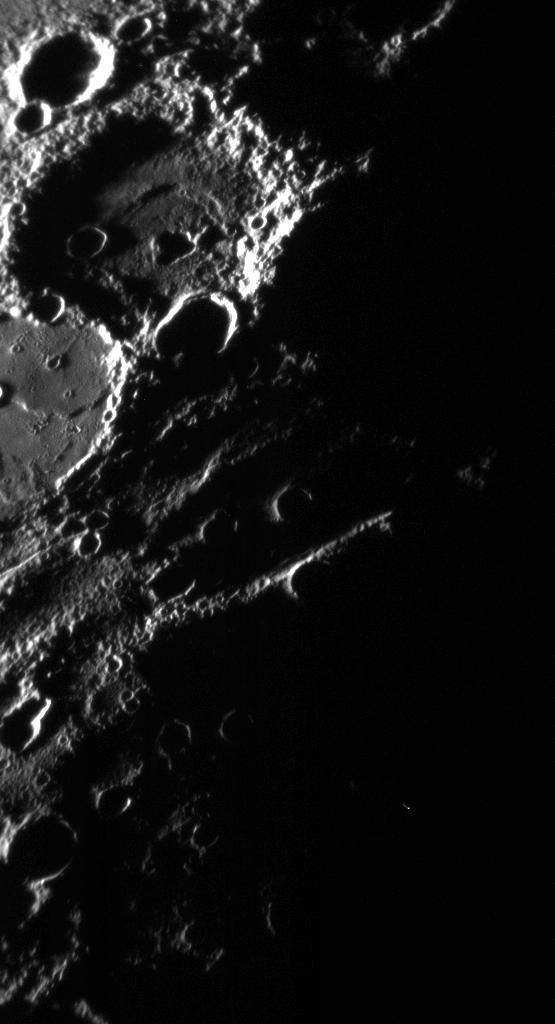
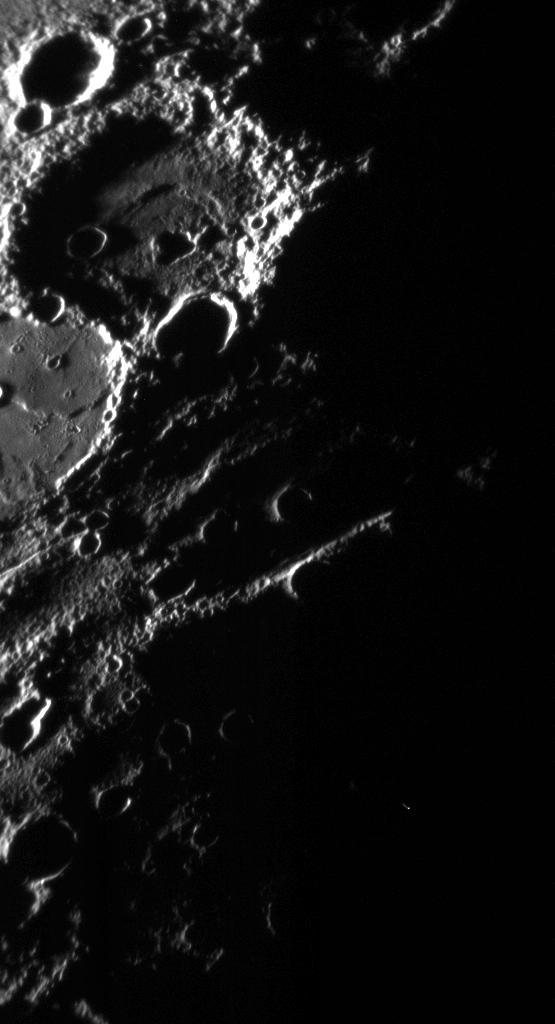
The MESSENGER spacecraft was flying toward Mercury at 3.7 kilometers/second (8300 miles/hour) when it captured this image. The Sun was just above the horizon, and the deep shadows it cast emphasized the texture and topography of the terrain along the terminator (day/night boundary). The large crater at upper left has a rough rim and walls, and the floor of this crater has a sunken inner circular area. At the center of the sunken floor section is an irregular depression (or pit) that is entirely in shadow in this view. Just to the south-southwest is the right half of another large crater whose rim intersects that of the crater with the sunken floor. The southern crater is about the same diameter as its northern neighbor, but instead of exhibiting a sunken floor with a pit, it has been filled nearly to its rim with smooth material likely of volcanic origin. These two close neighbors, one empty and one full, attest to the surprisingly complicated geological history of the little planet closest to the Sun.
Date Acquired: September 29, 2009
Image Mission Elapsed Time (MET): 162744138
Instrument: Narrow Angle Camera (NAC) of the Mercury Dual Imaging System (MDIS)
Resolution: 400 meters/pixel (0.25 miles/pixel)
Scale: This image is about 220 kilometers (140 miles) wide
Spacecraft Altitude: 15,700 kilometers (9800 miles)
These images are from MESSENGER, a NASA Discovery mission to conduct the first orbital study of the innermost planet, Mercury. For information regarding the use of images, see the MESSENGER image use policy.