Figure 1
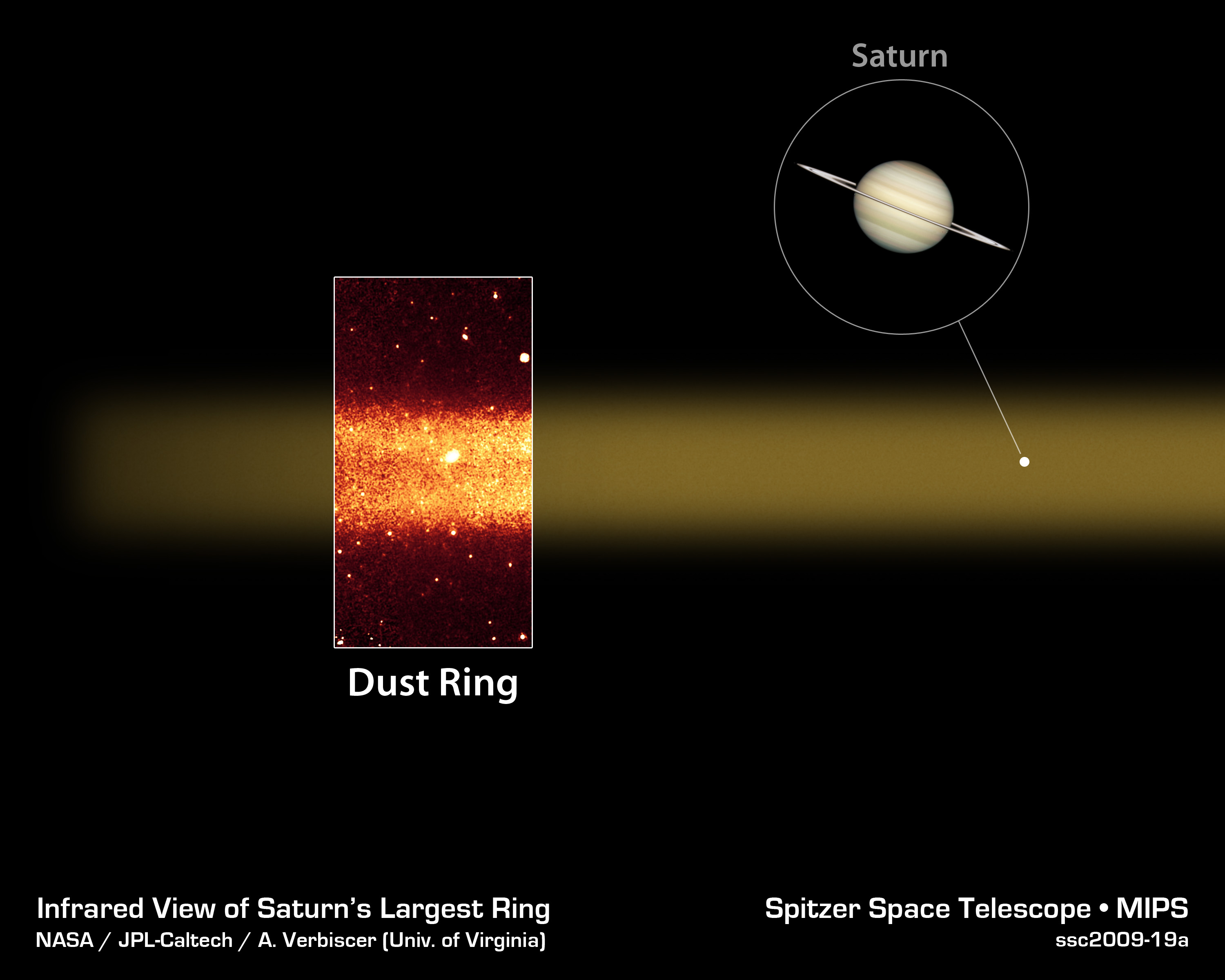
Click on the image for larger versionThis picture highlights a slice of Saturn's largest ring. The ring (red band in Figure 1) was discovered by NASA's Spitzer Space Telescope, which detected infrared light, or heat, from the dusty ring material. Spitzer viewed the ring edge-on from its Earth-trailing orbit around the sun.
The ring has a diameter equivalent to 300 Saturns lined up side to side. And it's thick too -- about 20 Saturns could fit into its vertical height. The ring is tilted about 27 degrees from Saturn's main ring plane.
The Spitzer data were taken by its multiband imaging photometer and show infrared light with a wavelength of 24 microns.
The picture of Saturn was taken by NASA's Hubble Space Telescope.