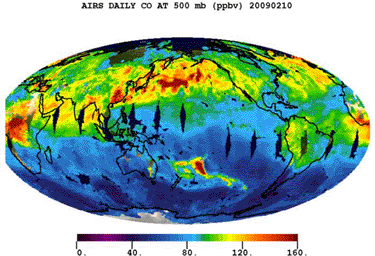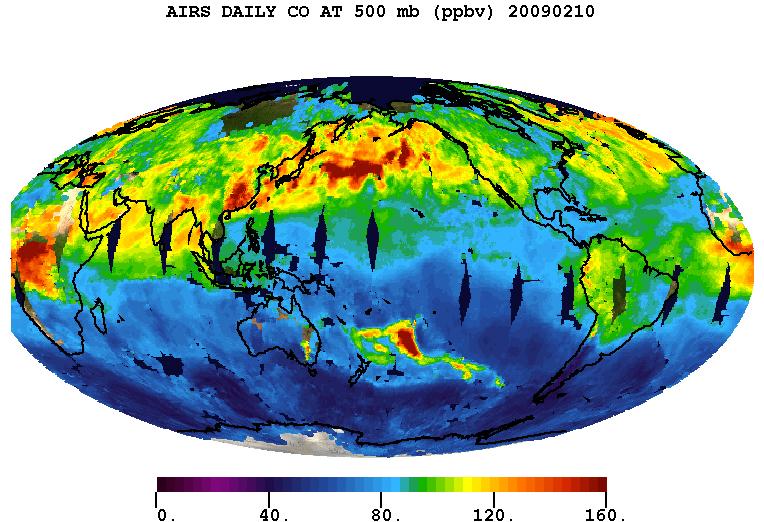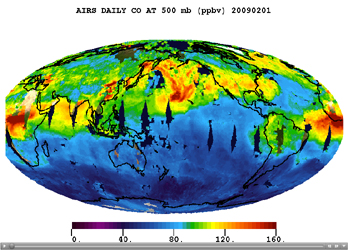
Click on the image for the animationIn February 2009, the deadliest wildfires in Australia's history left more than 200 dead and more than 1,800 homes destroyed. These large wildfires that displaced more than 7,500 people lofted carbon monoxide high into the atmosphere.
This movie shows daily retrieved carbon monoxide levels at 500 hPa (an altitude of approximately 18,000 feet or 5,486 meters) from the Atmospheric Infrared Sounder (AIRS) instrument on NASA's Aqua spacecraft for the first 17 days of February, 2009. The carbon monoxide from the fires bursts fourth from the Southeastern tip of Australia on February 7th and is carried by the atmospheric winds Eastward as far as the tip of South America on February 11th. The carbon monoxide clouds dissipate by February 17th.
About AIRS
The Atmospheric Infrared Sounder, AIRS, in conjunction with the Advanced Microwave Sounding Unit, AMSU, senses emitted infrared and microwave radiation from Earth to provide a three-dimensional look at Earth's weather and climate. Working in tandem, the two instruments make simultaneous observations all the way down to Earth's surface, even in the presence of heavy clouds. With more than 2,000 channels sensing different regions of the atmosphere, the system creates a global, three-dimensional map of atmospheric temperature and humidity, cloud amounts and heights, greenhouse gas concentrations, and many other atmospheric phenomena. Launched into Earth orbit in 2002, the AIRS and AMSU instruments fly onboard NASA's Aqua spacecraft and are managed by NASA's Jet Propulsion Laboratory in Pasadena, Calif., under contract to NASA. JPL is a division of the California Institute of Technology in Pasadena.
More information about AIRS can be found at http://airs.jpl.nasa.gov.