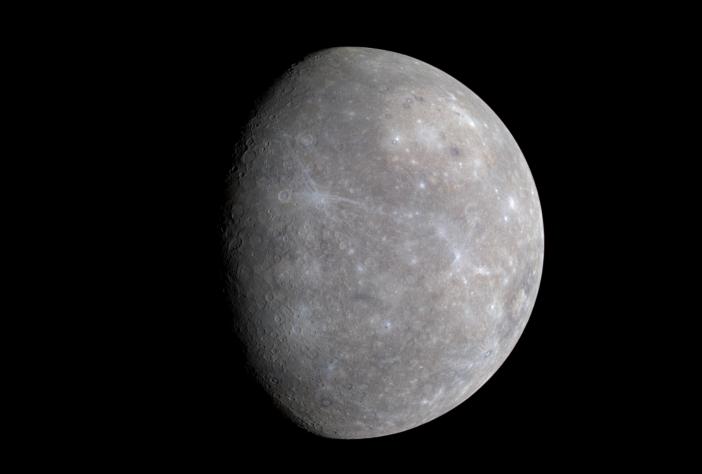
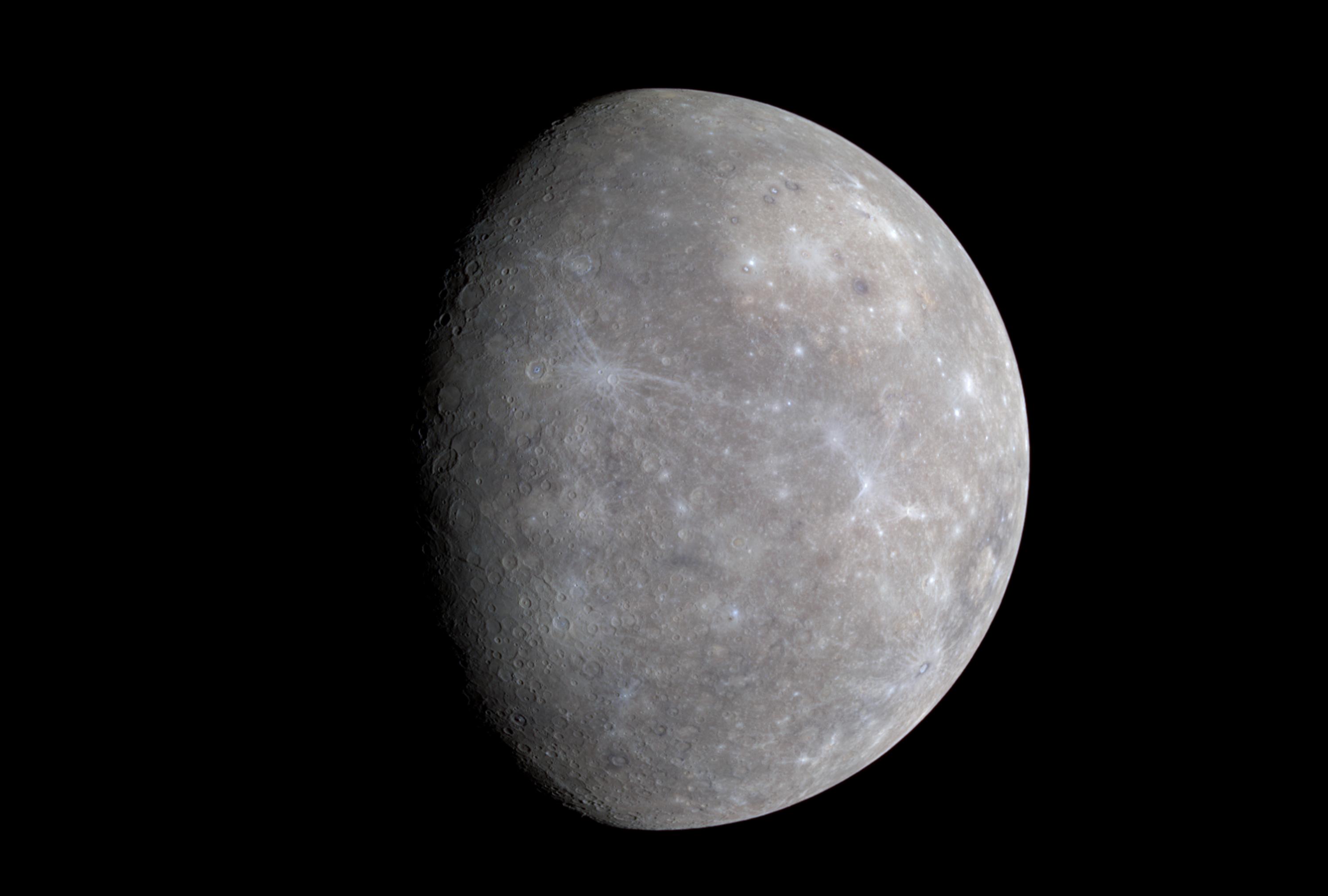
MESSENGER's Wide Angle Camera (WAC), part of the Mercury Dual Imaging System (MDIS), is equipped with 11 narrow-band color filters. As the spacecraft receded from Mercury after making its closest approach on January 14, 2008, the WAC recorded a 3x3 mosaic covering part of the planet not previously seen by spacecraft. The color image shown here was generated by combining the mosaics taken through the WAC filters that transmit light at wavelengths of 1000 nanometers (infrared), 700 nanometers (far red), and 430 nanometers (violet). These three images were placed in the red, green, and blue channels, respectively, to create the visualization presented here. The human eye is sensitive only across the wavelength range from about 400 to 700 nanometers. Creating a false-color image in this way accentuates color differences on Mercury's surface that cannot be seen in black-and-white (single-color) images.
Color differences on Mercury are subtle, but they reveal important information about the nature of the planet's surface material. A number of bright spots with a bluish tinge are visible in this image. These are relatively recent impact craters. Some of the bright craters have bright streaks (called "rays" by planetary scientists) emanating from them. Bright features such as these are caused by the presence of freshly crushed rock material that was excavated and deposited during the highly energetic collision of a meteoroid with Mercury to form an impact crater. The large circular light-colored area in the upper right of the image is the interior of the Caloris basin. Mariner 10 viewed only the eastern (right) portion of this enormous impact basin, under lighting conditions that emphasized shadows and elevation differences rather than brightness and color differences. MESSENGER has revealed that Caloris is filled with smooth plains that are brighter than the surrounding terrain, hinting at a compositional contrast between these geologic units. The interior of Caloris also harbors several unusual dark-rimmed craters, which are visible in this image. The MESSENGER science team is working with the 11-color images in order to gain a better understanding of what minerals are present in these rocks of Mercury's crust.
The diameter of Mercury is about 4880 kilometers (3030 miles). The image spatial resolution is about 2.5 kilometers per pixel (1.6 miles/pixel). The WAC departure mosaic sequence was executed by the spacecraft from approximately 19:45 to 19:56 UTC on January 14, 2008, when the spacecraft was moving from a distance of roughly 12,800 to 16,700 km (7954 to 10377 miles) from the surface of Mercury.
These images are from MESSENGER, a NASA Discovery mission to conduct the first orbital study of the innermost planet, Mercury. For information regarding the use of images, see the MESSENGER image use policy.