 |  |
| Figure 1 | Figure 2 |
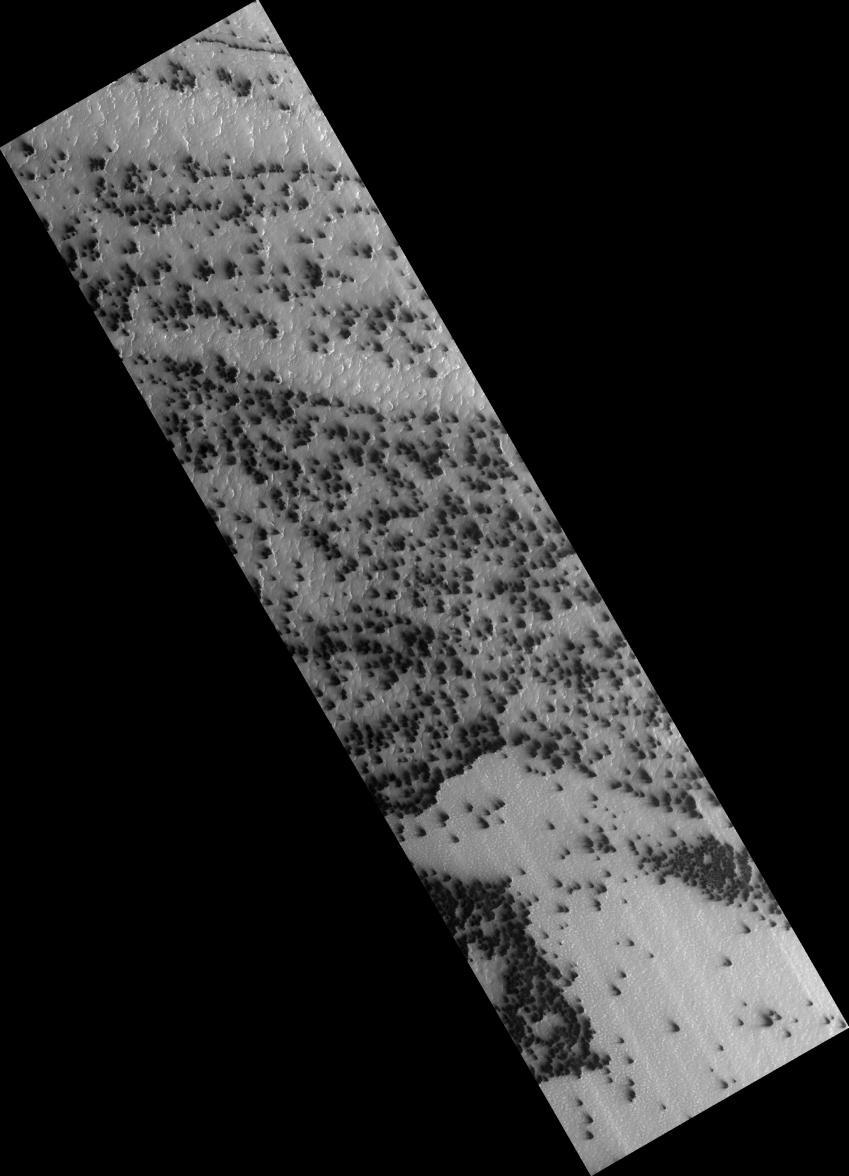
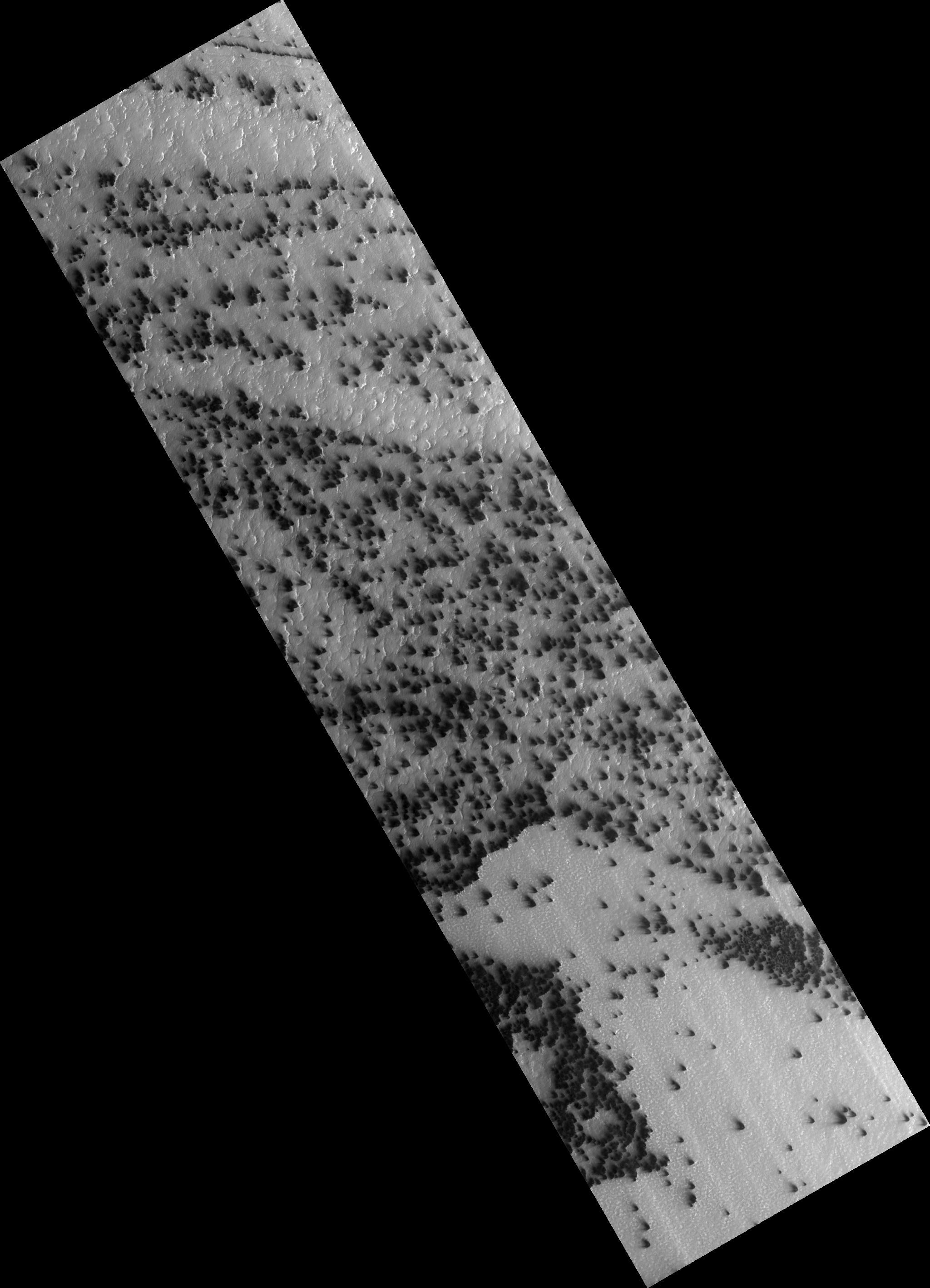
In a region of the south pole known informally as "Ithaca" numerous fans of dark frost form every spring. HiRISE collected a time lapse series of these images, starting at Ls = 185 and culminating at Ls = 294. "Ls" is the way we measure time on Mars: at Ls = 180 the sun passes the equator on its way south; at Ls = 270 it reaches its maximum subsolar latitude and summer begins.
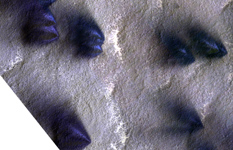
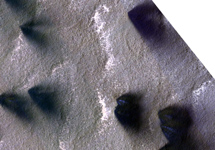
In the earliest image (figure 1) fans are dark, but small narrow bright streaks can be detected. In the next image (figure 2), acquired at Ls = 187, just 106 hours later, dramatic differences are apparent. The dark fans are larger and the bright fans are more pronounced and easily detectable. The third image in the sequence shows no bright fans at all.
We believe that the bright streaks are fine frost condensed from the gas exiting the vent. The conditions must be just right for the bright frost to condense.
Observation Geometry
Image PSP_002622_0945 was taken by the High Resolution Imaging Science Experiment (HiRISE) camera onboard the Mars Reconnaissance Orbiter spacecraft on 16-Feb-2007. The complete image is centered at -85.2 degrees latitude, 181.5 degrees East longitude. The range to the target site was 246.9 km (154.3 miles). At this distance the image scale is 49.4 cm/pixel (with 2 x 2 binning) so objects ~148 cm across are resolved. The image shown here has been map-projected to 50 cm/pixel . The image was taken at a local Mars time of 05:46 PM and the scene is illuminated from the west with a solar incidence angle of 88 degrees, thus the sun was about 2 degrees above the horizon. At a solar longitude of 185.1 degrees, the season on Mars is Northern Autumn.
NASA's Jet Propulsion Laboratory, a division of the California Institute of Technology in Pasadena, manages the Mars Reconnaissance Orbiter for NASA's Science Mission Directorate, Washington. Lockheed Martin Space Systems, Denver, is the prime contractor for the project and built the spacecraft. The High Resolution Imaging Science Experiment is operated by the University of Arizona, Tucson, and the instrument was built by Ball Aerospace and Technology Corp., Boulder, Colo.