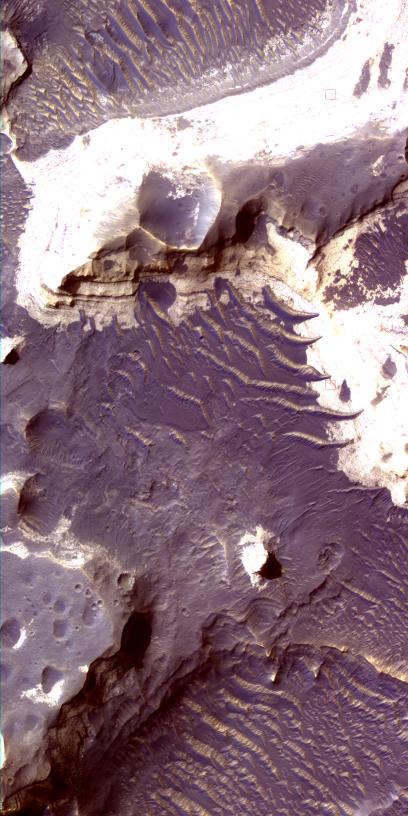
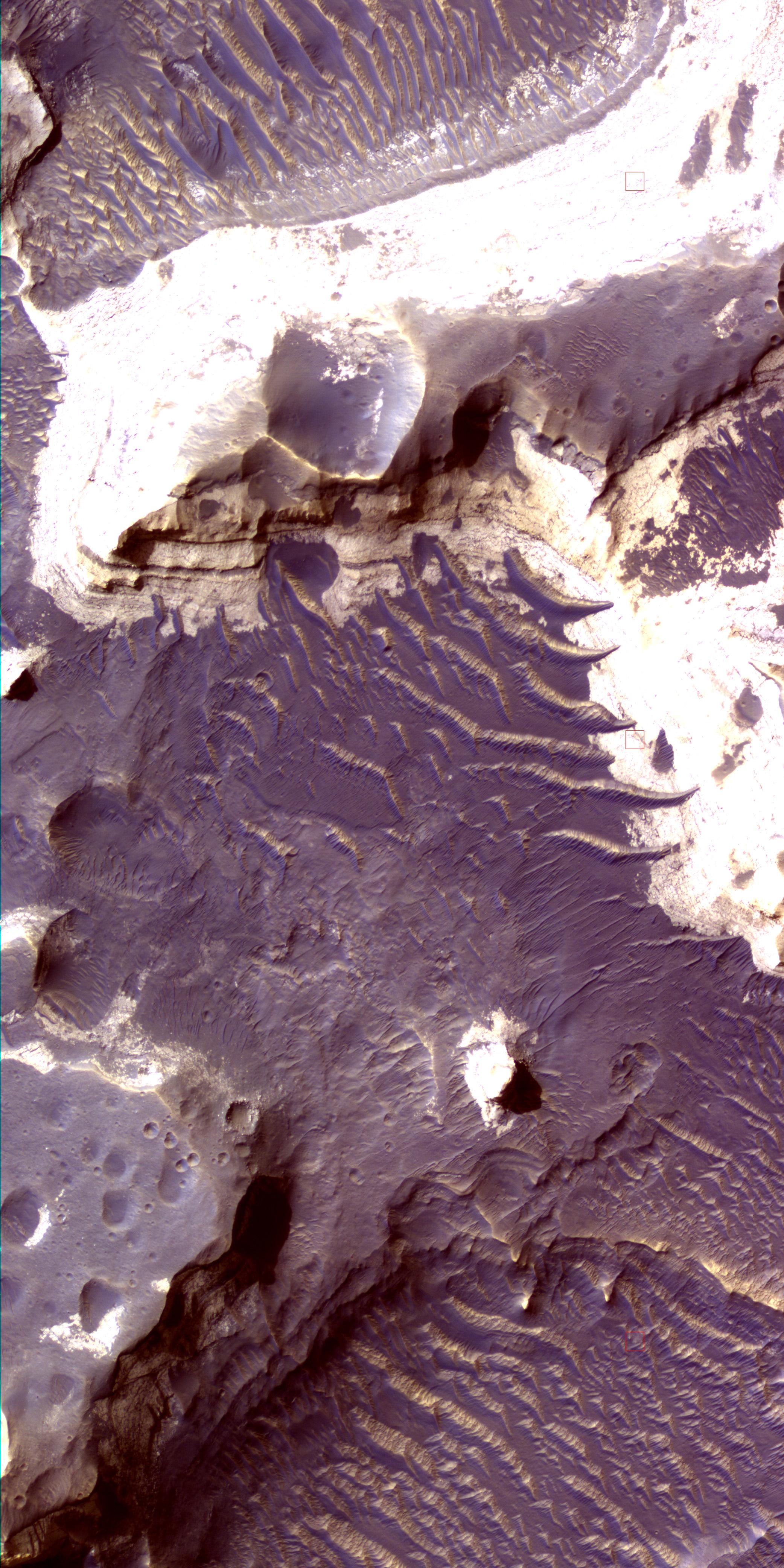
Layers inside Holden Crater in the southern hemisphere of Mars are shown in enhanced color in this image from the High Resolution Imaging Science Experiment (HiRISE) camera on NASA's Mars Reconnaissance Orbiter. The image was taken on December 4, 2006, as part of a campaign to examine more than two dozen candidate landing sites for the NASA Mars Science Laboratory rover, which is scheduled for launch in 2009.
Holden is one of the most interesting locations for scientists investigating the history of water on Mars because the crater contains deep gullies carved by running water, as well as excellent examples of likely lake beds and alluvial fans (sediment deposited by streams) on its floor. These deposits are about 3.7 billion years old and date back to a wetter period of early Martian history. Since that time the planet has generally been very cold and dry, and water has remained frozen in the polar regions or middle latitudes.
The cliff shown in this frame is located on the southwestern part of the crater floor. Many of the bright, flat-lying, possible lake-bed deposits near the bottom of the cliff are each less than a meter or yard thick. After these lake beds were deposited, a massive flood entered Holden Crater from the southwest and deposited the layer of dark boulders and gravel that are now exposed near the top of the cliff. After the lake dried up, wind eroded the surface and formed the ripples and dunes seen in the valley. The circular pits are impact craters formed by meteorite strikes onto the ancient deposits.
The area covered by this image is about 600 meters (about one-third of a mile) across, at 26.8 degrees south latitude, 34.7 degrees west longitude. North is up. The view is a composite of exposures that HiRISE took in the infrared, red and blue portions of the spectrum. Color is enhanced, a technique useful for analyzing landscapes.
This is a portion of the full-frame color image catalogued as PSP_001666_1530 in the HiRISE collection. It was taken at a local Mars time of 3:41 p.m. The scene is illuminated from the west with a solar incidence angle of 68 degrees, thus the sun was about 22 degrees above the horizon. The season on Mars was northern autumn.
 Planetary Data System