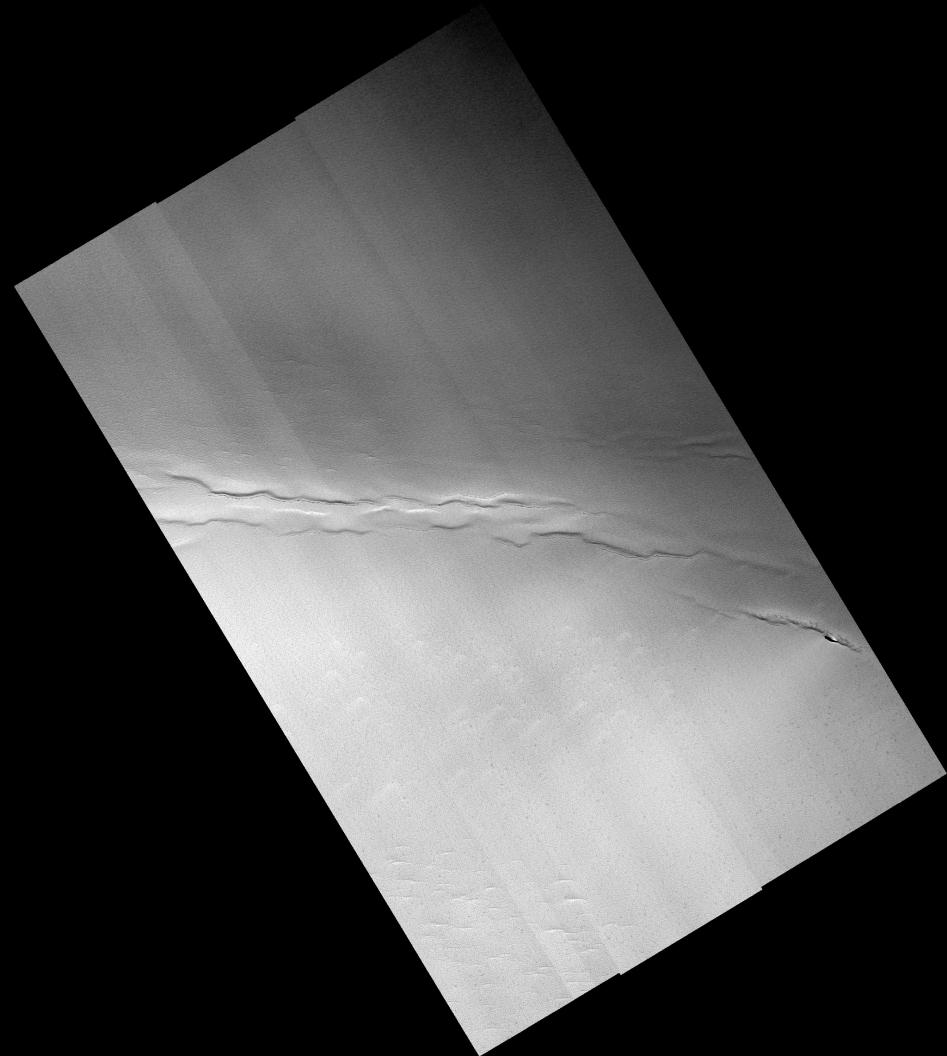
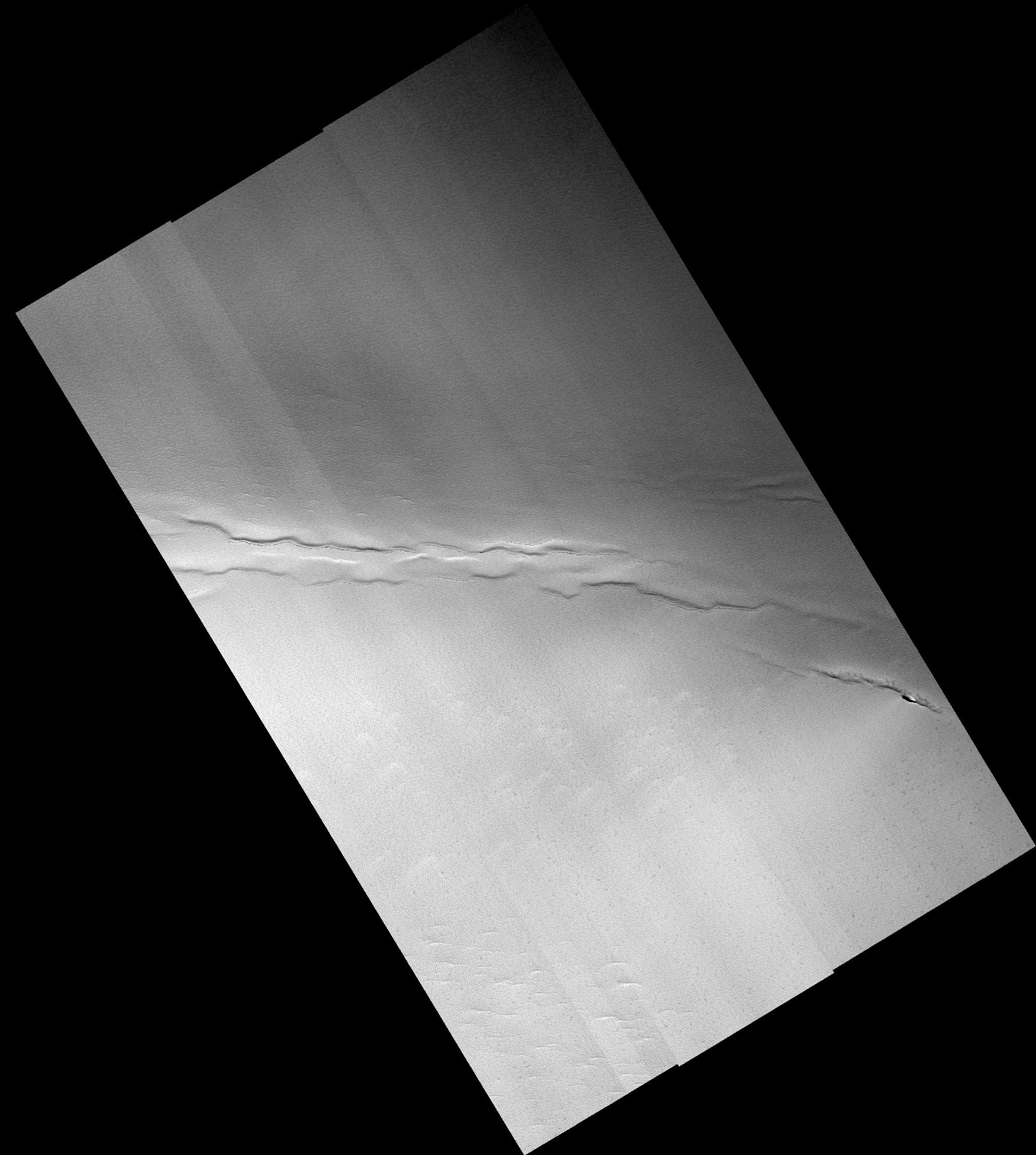
This full-frame image from the High Resolution Imaging Science Experiment camera on NASA's Mars Reconnaissance Orbiter shows faults and pits in Mars' north polar residual cap that have not been previously recognized.
The faults and depressions between them are similar to features seen on Earth where the crust is being pulled apart. Such tectonic extension must have occurred very recently because the north polar residual cap is very young, as indicated by the paucity of impact craters on its surface. Alternatively, the faults and pits may be caused by collapse due to removal of material beneath the surface. The pits are aligned along the faults, either because material has drained into the subsurface along the faults or because gas has escaped from the subsurface through them.
NASA's Jet Propulsion Laboratory, a division of the California Institute of Technology in Pasadena, manages the Mars Reconnaissance Orbiter for NASA's Science Mission Directorate, Washington. Lockheed Martin Space Systems, Denver, is the prime contractor for the project and built the spacecraft. The High Resolution Imaging Science Experiment is operated by the University of Arizona, Tucson, and the instrument was built by Ball Aerospace and Technology Corp., Boulder, Colo.