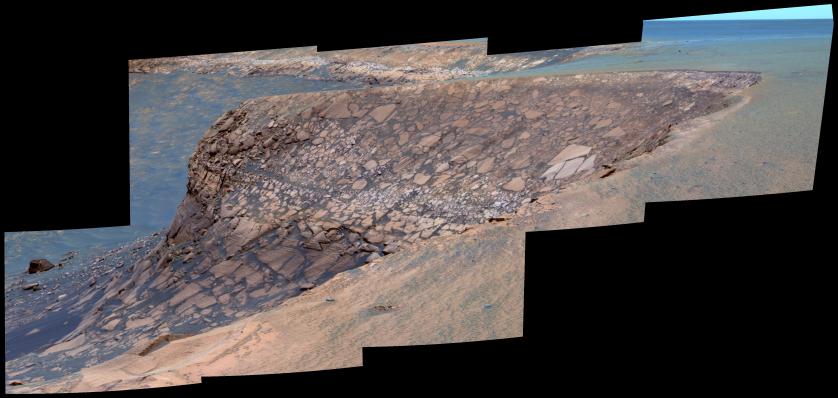
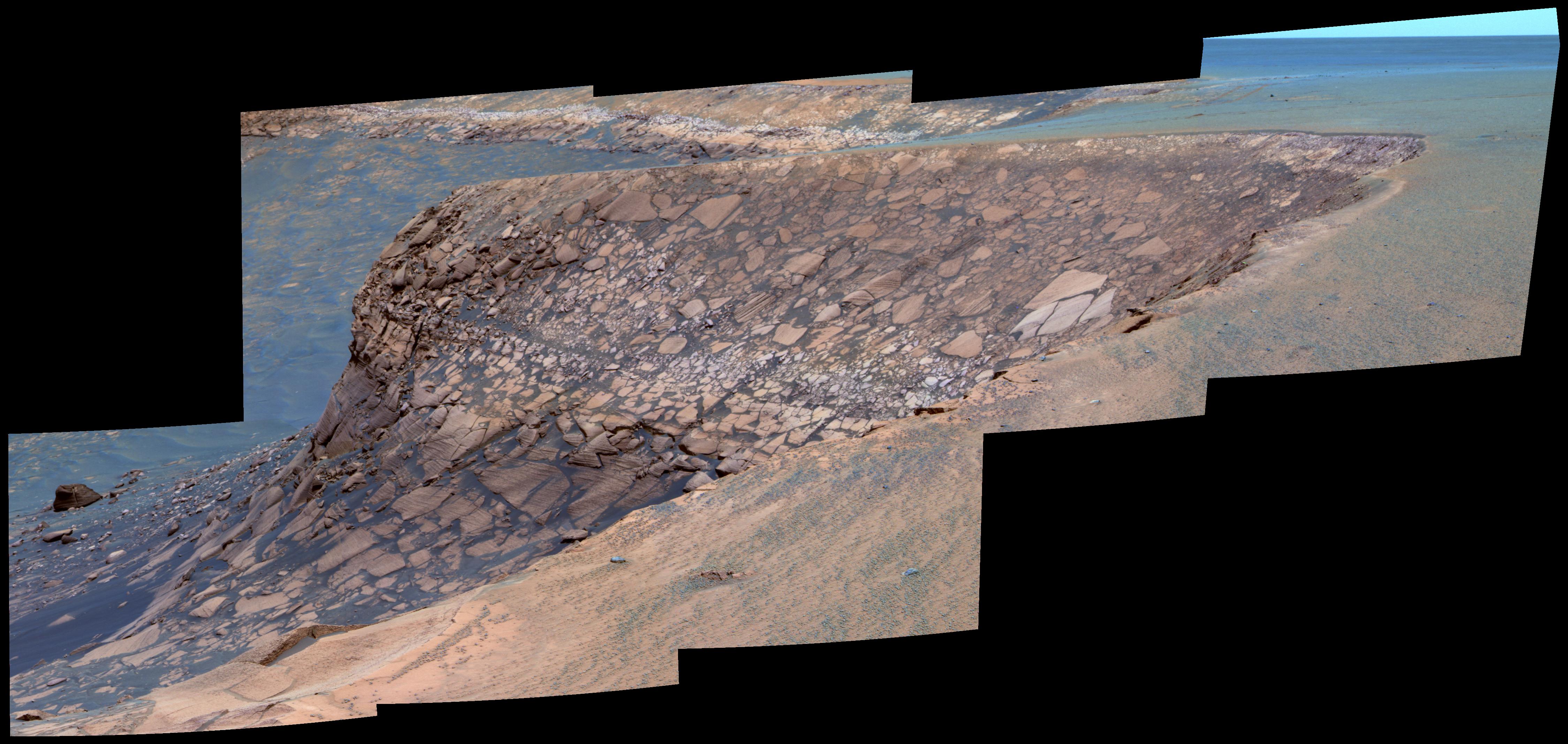
As part of its investigation of "Victoria Crater," NASA's Mars Exploration Rover Opportunity examined a promontory called "Cape Verde" from the vantage point of "Cape St. Mary," the next promontory clockwise around the crater's deeply scalloped rim. This view of Cape Verde combines several exposures taken by the rover's panoramic camera into a false-color mosaic. The exposures were taken during late-morning lighting conditions.
The upper portion of the crater wall contains a jumble of material tossed outward by the impact that excavated the crater. This vertical cross-section through the blanket of ejected material surrounding the crater was exposed by erosion that expanded the crater outward from its original diameter, according to scientists' interpretation of the observations. Below the jumbled material in the upper part of the wall are layers that survive relatively intact from before the crater-causing impact.
The images combined into this mosaic were taken during the 1,006th Martian day, or sol, of Opportunity's Mars-surface mission (Nov. 22, 2006). The panoramic camera took them through the camera's 750-nanometer, 530-nanometer and 430-nanometer filters. The false color enhances subtle color differences among materials in the rocks and soils of the scene.