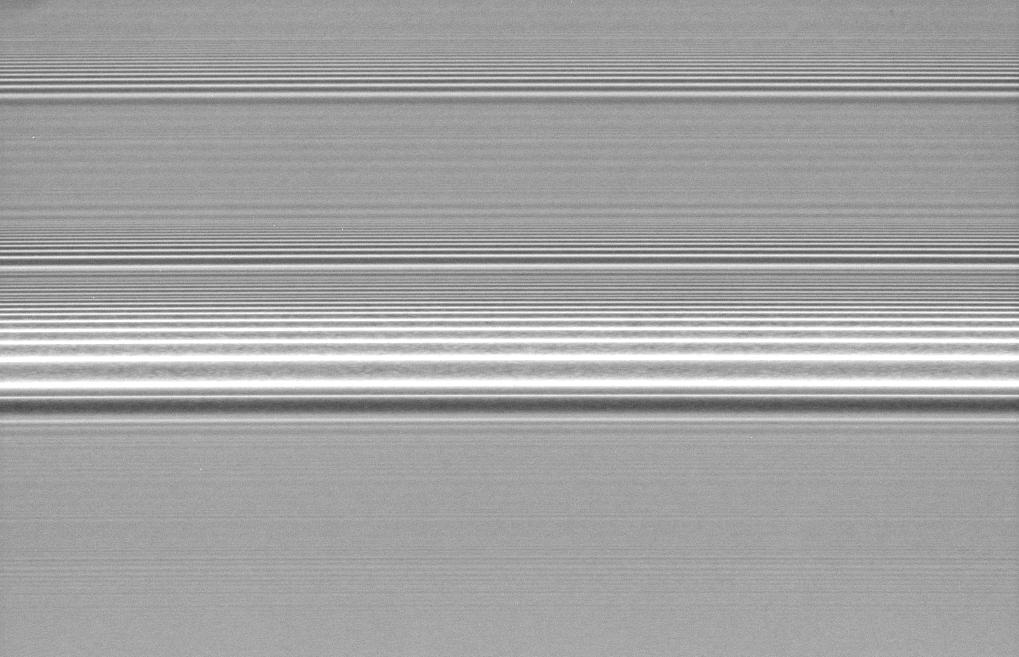
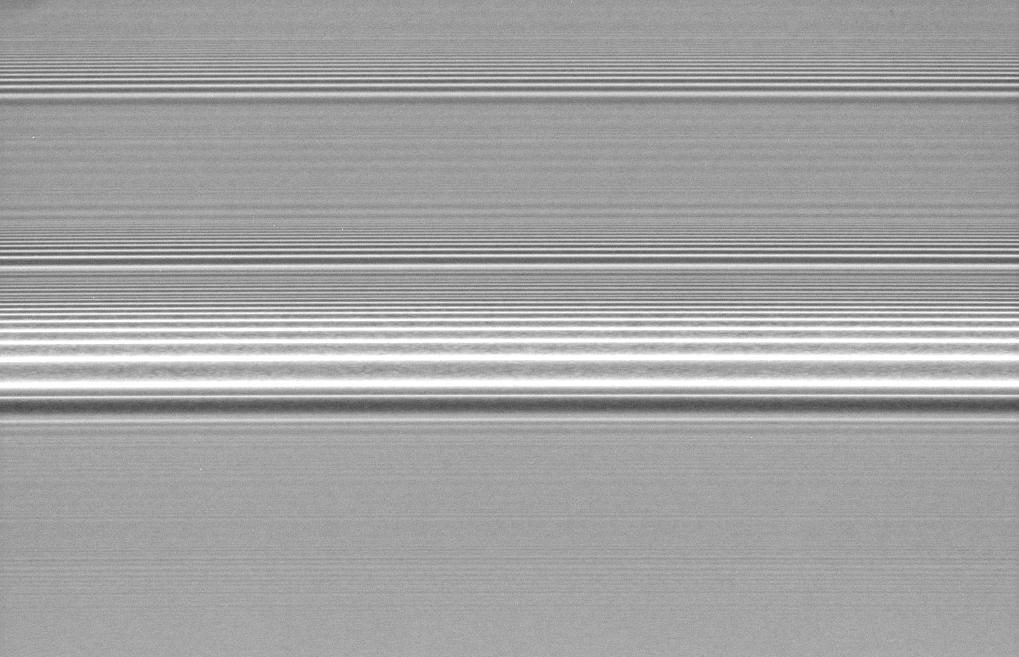
Several spiral density waves in Saturn's A ring are seen in this detailed view. There is a grainy texture visible between the brightness peaks in the most prominent wave. Scientists think the graininess might be indicative of self-gravitating clumps of material that are formed by the spiraling wave.
Downward in the image represents the direction toward Saturn. This view looks toward the lit side of the rings from about 42 degrees below the ringplane.
The image was taken in visible light with the Cassini spacecraft wide-angle camera on Nov. 8, 2006. Cassini was then at a distance of approximately 300,000 kilometers (200,000 miles) from Saturn and at a Sun-Saturn-spacecraft, or phase, angle of 27 degrees. Image scale is 1 kilometer (4,580 feet) per pixel.
The Cassini-Huygens mission is a cooperative project of NASA, the European Space Agency and the Italian Space Agency. The Jet Propulsion Laboratory, a division of the California Institute of Technology in Pasadena, manages the mission for NASA's Science Mission Directorate, Washington, D.C. The Cassini orbiter and its two onboard cameras were designed, developed and assembled at JPL. The imaging operations center is based at the Space Science Institute in Boulder, Colo.
For more information about the Cassini-Huygens mission visit http://saturn.jpl.nasa.gov/home/index.cfm. The Cassini imaging team homepage is at http://ciclops.org.