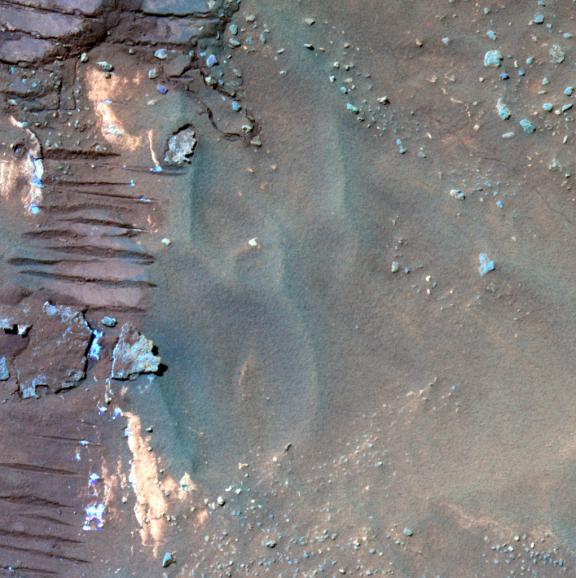
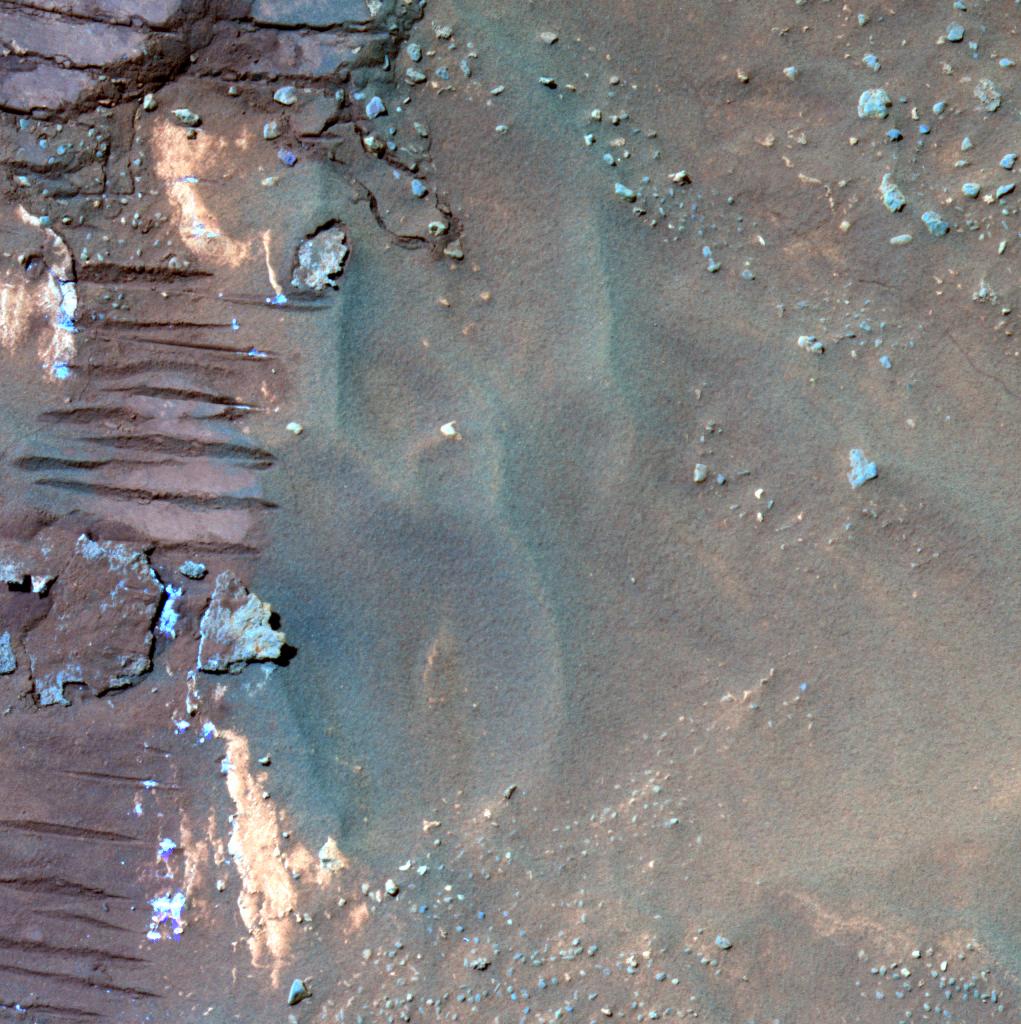
Stretching along "Low Ridge" in front of the winter haven for NASA's Mars Exploration Rover Spirit are several continuous rock layers that make up the ridge. Some of these layers form fins that stick out from the other rocks in a way that suggests that they are resistant to erosion. Spirit is currently straddling one of these fin-like layers and can reach a small bit of light-toned material that might be a broken bit of it. Informally named "Halley," this rock was broken by Spirit's wheels when the rover drove over it.
The first analyses of Halley showed it to be unusual in composition, containing a lot of the minor element zinc relative to the soil around it and having much of its iron tied up in the mineral hematite. When scientists again placed the scientific instruments on Spirit's robotic arm on a particularly bright-looking part of Halley, they found that the chemical composition of the bright spots was suggestive of a calcium sulfate mineral. Bright soils that Spirit has examined earlier in the mission contain iron sulfate.
This discovery raises new questions for the science team: Why is the sulfate mineralogy here different? Did Halley and the fin material form by water percolating through the layered rocks of Low Ridge? When did the chemical alteration of this rock occur? Spirit will continue to work on Halley and other light-toned materials along Low Ridge in the coming months to try to answer these questions.
Spirit took this red-green-blue composite image with the panoramic camera on the rover's 820th sol, or Martian day, of exploring Mars (April 24, 2006). The image is presented in false color to emphasize differences among materials in the rocks and soil. It combines frames taken through the camera's 750-nanometer, 530-nanometer, and 430-nanometer filters. The middle of the imaged area has dark basaltic sand. Spirit's wheel track is at the left edge of the frame. Just to the right of the wheel track in the lower left are two types of brighter material examined by Spirit at the Halley target. The bluer material yielded the evidence for a calcium sulfate mineral.