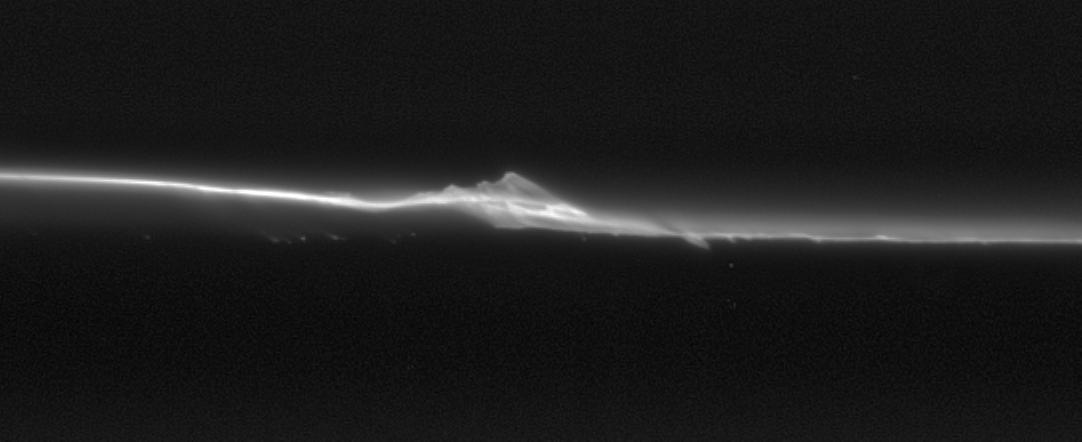
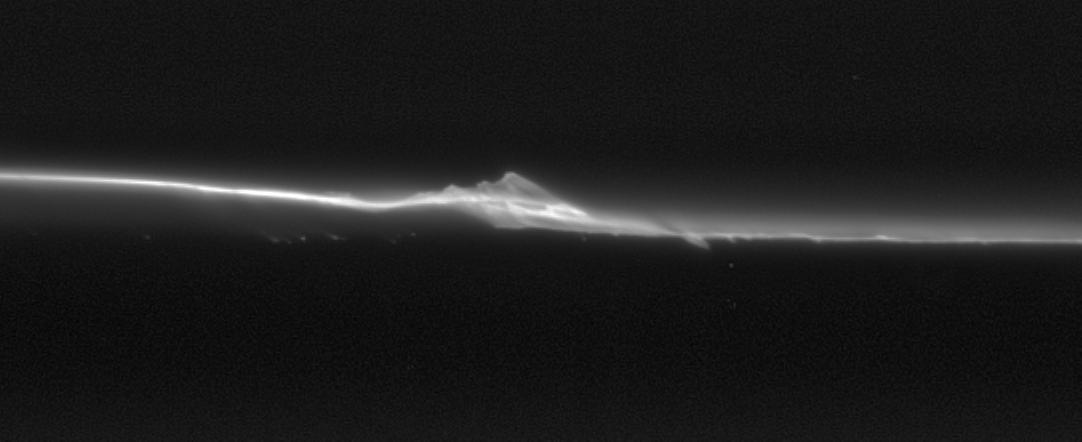
The Cassini spacecraft has revealed a never-before-seen level of detail in Saturn's F ring, including evidence for the perturbing effect of small moonlets orbiting in or close to the ring's bright core.
For some time, scientists have suspected the presence of tiny moonlets that orbit Saturn in association with the clumpy ring. As the small satellites move close to the F ring core they leave a gravitational signature. In some cases they can draw out material in the form of a "streamer"—a miniature version of the interaction Cassini has witnessed between Prometheus and the F ring material. The dynamics of this interaction are the same, but the scale is different. See PIA06143 for a view of Prometheus creating a streamer.
Scientists speculate that there could be several small moons with a variety of sizes involved in the creation of structures like the one seen here.
The image was taken in visible light with the Cassini spacecraft narrow-angle camera on Sept. 25, 2006 at a distance of approximately 255,000 kilometers (159,000 miles) from Saturn and at a Sun-Saturn-spacecraft, or phase, angle of 29 degrees. Scale in the original image was 1 kilometer (3,873 feet) per pixel. The image has been magnified by a factor of two and contrast enhanced.
The Cassini-Huygens mission is a cooperative project of NASA, the European Space Agency and the Italian Space Agency. The Jet Propulsion Laboratory, a division of the California Institute of Technology in Pasadena, manages the mission for NASA's Science Mission Directorate, Washington, D.C. The Cassini orbiter and its two onboard cameras were designed, developed and assembled at JPL. The imaging operations center is based at the Space Science Institute in Boulder, Colo.
For more information about the Cassini-Huygens mission visit http://saturn.jpl.nasa.gov/home/index.cfm. The Cassini imaging team homepage is at http://ciclops.org.