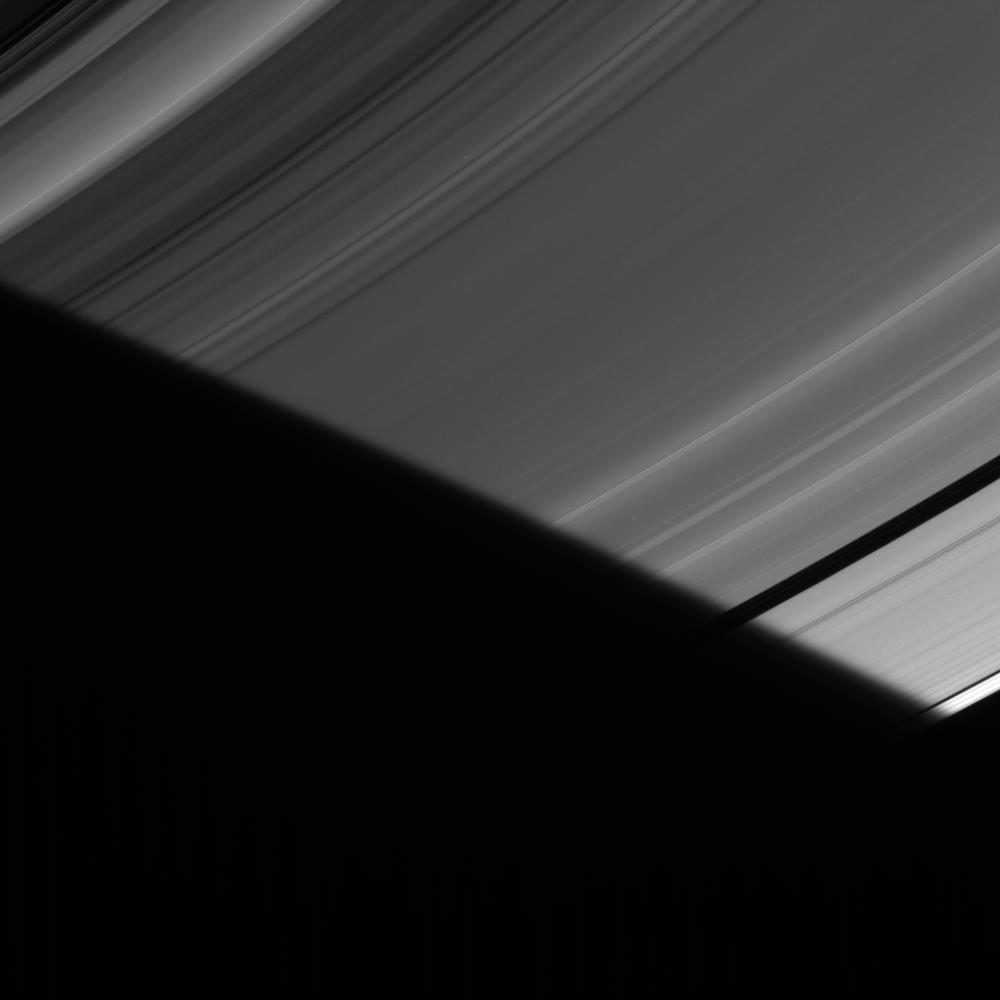
As the particles comprising Saturn's A ring slip into the planet's shadow, they find themselves briefly in the penumbra of Saturn's shadow. In this very narrow region along the edge of the shadow, part (but not all) of the Sun is still visible around the side of the planet, creating only a partial shadow there and making the shadow edge look fuzzy.
The image was taken in visible light with the Cassini spacecraft narrow-angle camera on July 26, 2006 at a distance of approximately 1.5 million kilometers (900,000 miles) from Saturn. Image scale is 9 kilometers (5 miles) per pixel.
The Cassini-Huygens mission is a cooperative project of NASA, the European Space Agency and the Italian Space Agency. The Jet Propulsion Laboratory, a division of the California Institute of Technology in Pasadena, manages the mission for NASA's Science Mission Directorate, Washington, D.C. The Cassini orbiter and its two onboard cameras were designed, developed and assembled at JPL. The imaging operations center is based at the Space Science Institute in Boulder, Colo.
For more information about the Cassini-Huygens mission visit http://saturn.jpl.nasa.gov/home/index.cfm. The Cassini imaging team homepage is at http://ciclops.org.