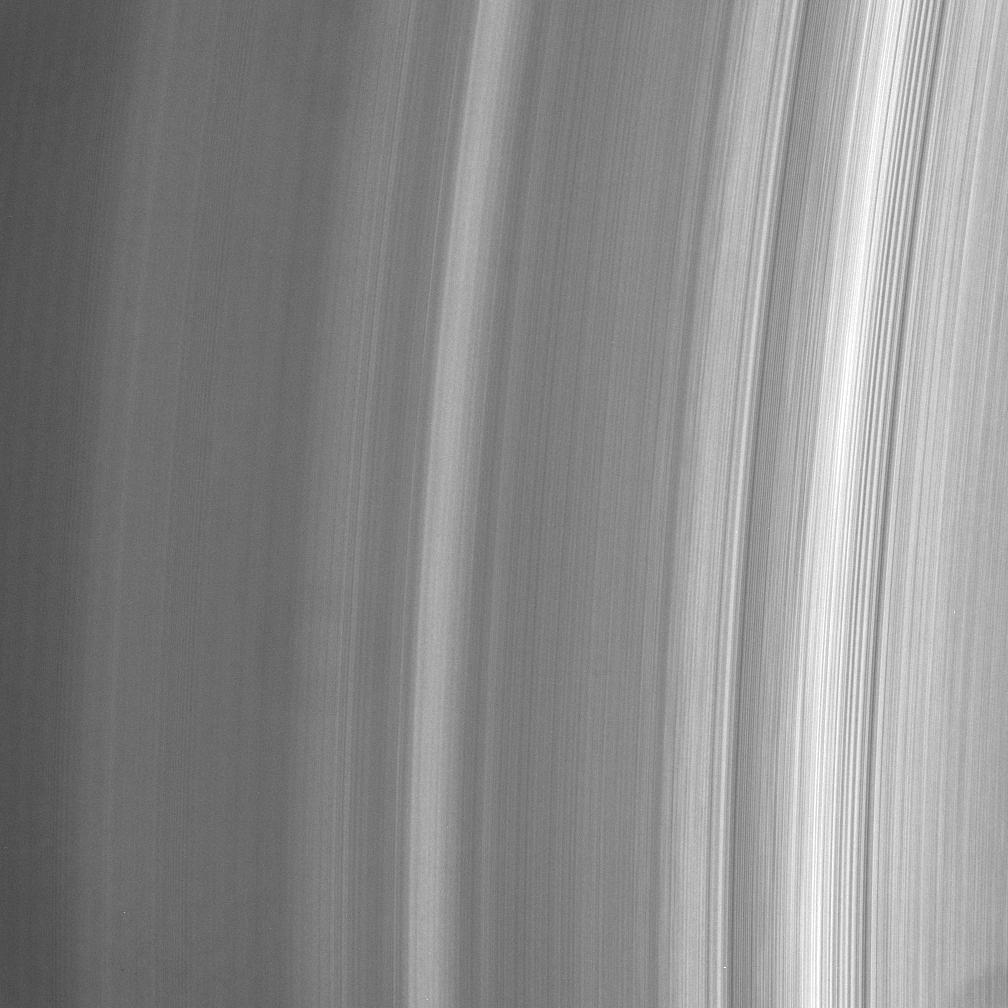
This close-up view of the inner A ring shows intriguing variations in brightness along the direction of ring motion -- from top to bottom. Close examination reveals dark regions that appear to widen and then narrow, and thin bright regions that disappear altogether.
Variations in brightness are to be expected in the direction of increasing orbital distance from Saturn, but variations along the azimuthal (or circumferential) direction are unusual, as they should be smoothed out quickly by ring particle motion.
(The faint "doughnut" left of center and the dark area in the lower right corner are imaging artifacts.)
The image was taken in visible light with the Cassini spacecraft narrow-angle camera on July 23, 2006 at a distance of approximately 285,000 kilometers (177,000 miles) from Saturn. Image scale is 1 kilometer (0.6 mile) per pixel.
The Cassini-Huygens mission is a cooperative project of NASA, the European Space Agency and the Italian Space Agency. The Jet Propulsion Laboratory, a division of the California Institute of Technology in Pasadena, manages the mission for NASA's Science Mission Directorate, Washington, D.C. The Cassini orbiter and its two onboard cameras were designed, developed and assembled at JPL. The imaging operations center is based at the Space Science Institute in Boulder, Colo.
For more information about the Cassini-Huygens mission visit http://saturn.jpl.nasa.gov/home/index.cfm. The Cassini imaging team homepage is at http://ciclops.org.