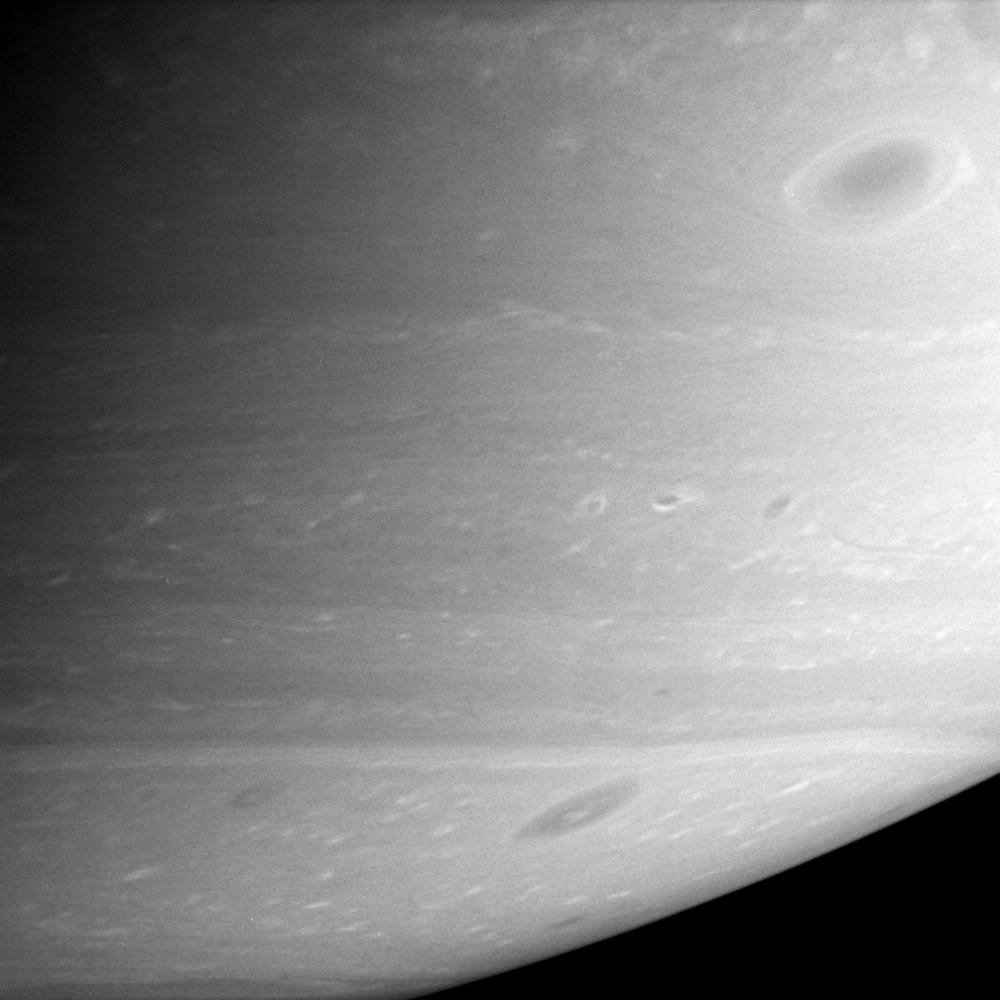
Saturn's atmosphere comes alive with a multitude of dark vortices swirling through the southern hemisphere.
Vortices are long-lived features that are part of the general circulation of Saturn's atmosphere. Vortices are thought to be caused by the shear between eastward- and westward-flowing jets -- the alternating bands flowing past each other in the atmosphere. The vortices can last for months or years and probably grow by merging with other vortices until a few dominate a particular zone of wind shear between two jets.
The vortex at upper right is one of the largest vortices on Saturn.
The image was taken with the Cassini spacecraft narrow-angle camera on Feb. 16, 2006 at a distance of approximately 3.2 million kilometers (2 million miles) from Saturn. The image scale is 19 kilometers (12 miles) per pixel.
The Cassini-Huygens mission is a cooperative project of NASA, the European Space Agency and the Italian Space Agency. The Jet Propulsion Laboratory, a division of the California Institute of Technology in Pasadena, manages the mission for NASA's Science Mission Directorate, Washington, D.C. The Cassini orbiter and its two onboard cameras were designed, developed and assembled at JPL. The imaging operations center is based at the Space Science Institute in Boulder, Colo.
For more information about the Cassini-Huygens mission visit http://saturn.jpl.nasa.gov/home/index.cfm. The Cassini imaging team homepage is at http://ciclops.org.