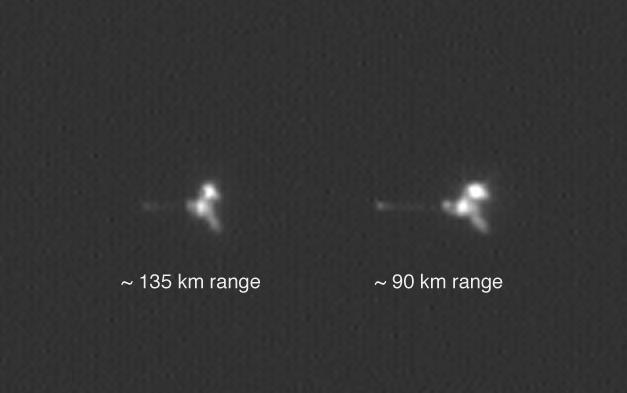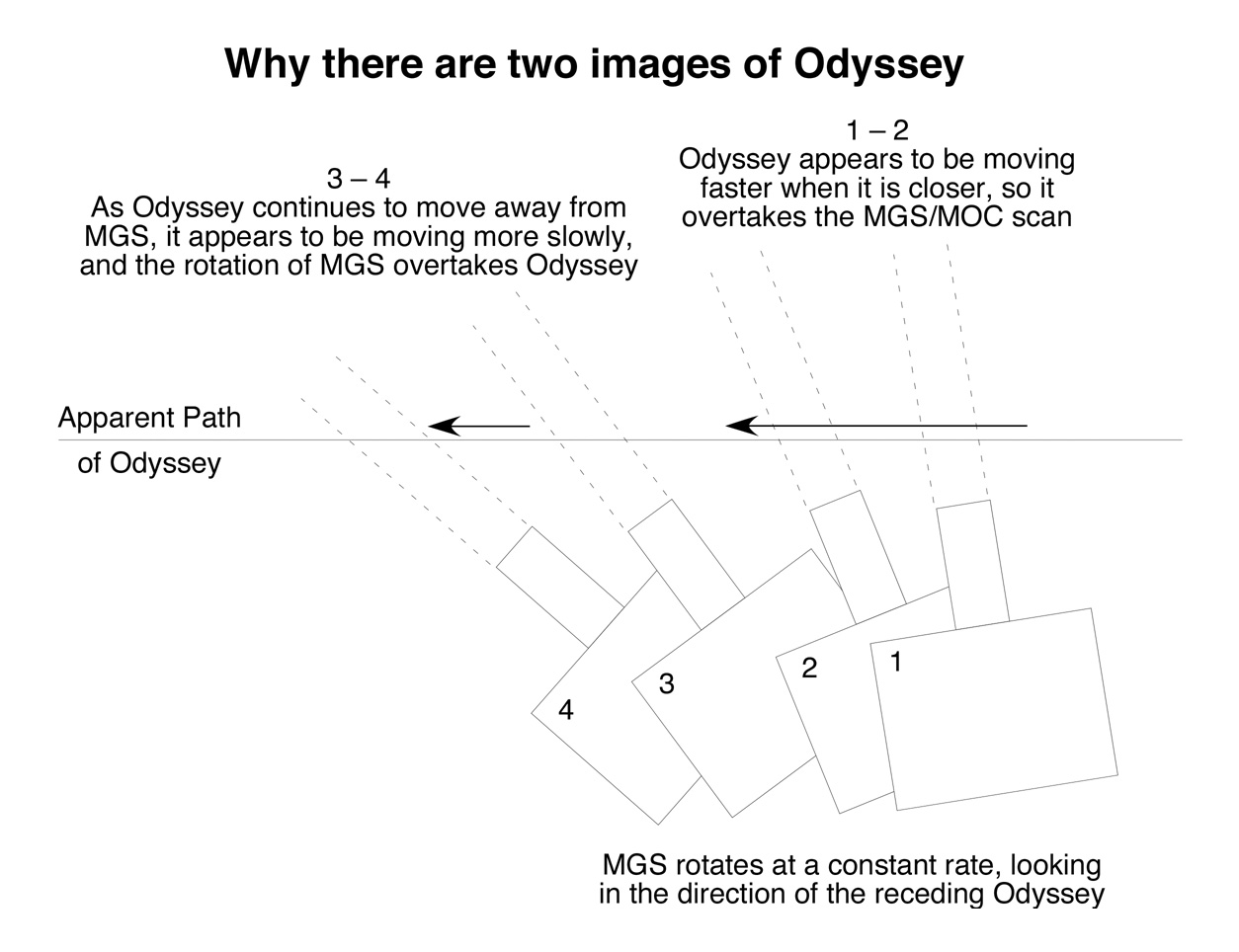
Figure 1: Why There are Two Images of OdysseyNASA's Mars Odyssey spacecraft appears twice in the same frame in this image from the Mars Orbiter Camera aboard NASA's Mars Global Surveyor. The camera's successful imaging of Odyssey and of the European Space Agency's Mars Express in April 2005 produced the first pictures of any spacecraft orbiting Mars taken by another spacecraft orbiting Mars.
Mars Global Surveyor and Mars Odyssey are both in nearly circular, near-polar orbits. Odyssey is in an orbit slightly higher than that of Global Surveyor in order to preclude the possibility of a collision. However, the two spacecraft occasionally come as close together as 15 kilometers (9 miles).
The images were obtained by the Mars Global Surveyor operations teamsat Lockheed Martin Space System, Denver; JPL and Malin Space ScienceSystems.
The two views of Mars Odyssey in this image were acquired a little under 7.5 seconds apart as Odyssey receded from a close flyby of Mars Global Surveyor. The geometry of the flyby (see Figure 1) and the camera's way of acquiring an image line-by-line resulted in the two views of Odyssey in the same frame. The first view (right) was taken when Odyssey was about 90 kilometers (56 miles) from Global Surveyor and moving more rapidly than Global Surveyor was rotating, as seen from Global Surveyor. A few seconds later, Odyssey was farther away -- about 135 kilometers (84 miles) -- and appeared to be moving more slowly. In this second view of Odyssey (left), the Mars Orbiter Camera's field-of-view overtook Odyssey.
The Mars Orbiter Camera can resolve features on the surface of Mars as small as a few meters or yards across from Mars Global Surveyor's orbital altitude of 350 to 405 kilometers (217 to 252 miles). From a distance of 100 kilometers (62 miles), the camera would be able to resolve features substantially smaller than 1 meter or yard across.
Mars Odyssey was launched on April 7, 2001, and reached Mars on Oct. 24, 2001. Mars Global Surveyor left Earth on Nov. 7, 1996, and arrived in Mars orbit on Sept. 12, 1997. Both orbiters are in an extended mission phase, both have relayed data from the Mars Exploration Rovers, and both are continuing to return exciting new results from Mars. JPL, a division of the California Institute of Technology, Pasadena, manages both missions for NASA's Science Mission Directorate, Washington, D.C.