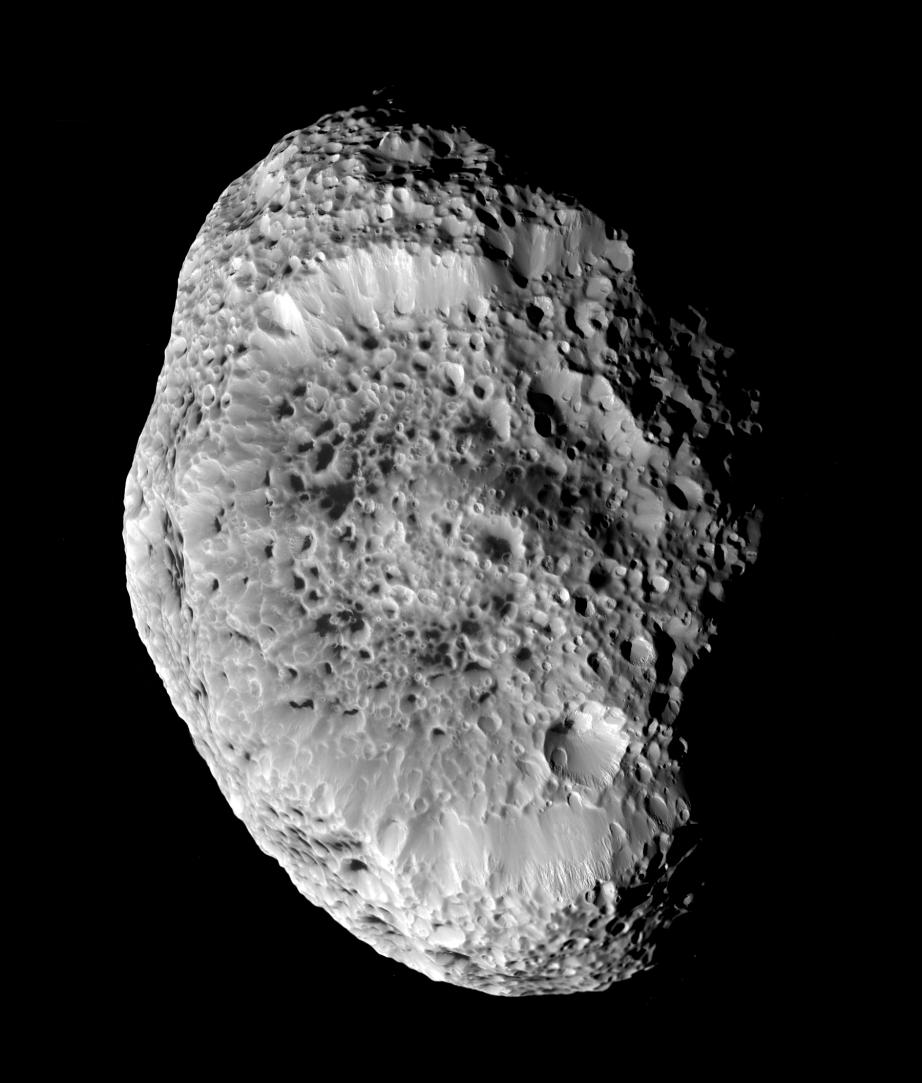
Saturn's impact-pummeled moon Hyperion stares back at the Cassini spacecraft in this six-image mosaic, taken during the spacecraft's close approach on Sept. 26, 2005.
This up-close view shows a low-density body blasted by impacts over eons. Scientists believe that the spongy appearance of Hyperion is caused by a phenomenon called thermal erosion, in which dark materials accumulating on crater floors are warmed by sunlight and melt deeper into the surface, allowing surrounding ice to vaporize away. At 280 kilometers, (174 miles) across, Hyperion's impact-shaped morphology makes it the largest of Saturn's irregularly-shaped moons.
Six, clear-filter images were combined to create this mosaic. Images were taken by the Cassini spacecraft narrow-angle camera at a mean distance of about 33,000 kilometers (20,500 miles) from Hyperion and at a Sun-Hyperion-spacecraft, or phase, angle of 51 degrees. Image scale is 197 meters (646 feet) per pixel.
The Cassini-Huygens mission is a cooperative project of NASA, the European Space Agency and the Italian Space Agency. The Jet Propulsion Laboratory, a division of the California Institute of Technology in Pasadena, manages the mission for NASA's Science Mission Directorate, Washington, D.C. The Cassini orbiter and its two onboard cameras were designed, developed and assembled at JPL. The imaging operations center is based at the Space Science Institute in Boulder, Colo.
For more information about the Cassini-Huygens mission visit http://saturn.jpl.nasa.gov. The Cassini imaging team homepage is at http://ciclops.org.