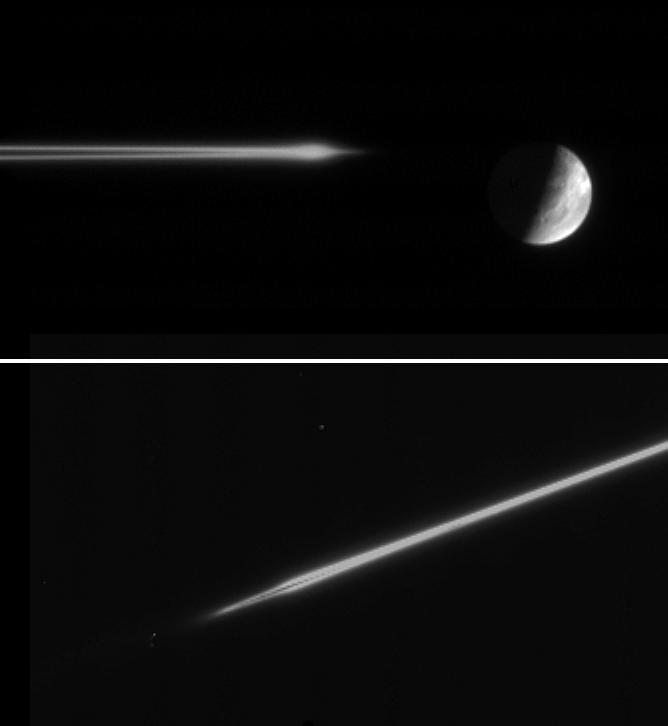
Viewing Saturn's rings very close to edge-on produces some puzzling effects, as these two images of the F ring demonstrate.
The upper image was acquired from less than a tenth of a degree beneath the ringplane and shows a mysterious bulge. Such a feature has not been seen previously by the Cassini spacecraft from this angle. It is possible that, because of the very shallow viewing angle, the Cassini spacecraft's view takes a long path through the ring, making very faint material visible. It also may be that an embedded object of a kilometer or so in size stirs up the neighboring ring particles to create a bulge. Alternatively, an impact into an embedded moonlet that was covered with debris could produce a cloud like this.
Images taken by the Voyager spacecrafts showed clumps that might have been produced in these ways. Cassini's investigations will help to determine the vertical extent of such clumps and understand their origins.
The lower image was obtained from less than a hundredth of a degree beneath the ringplane. Across the center of the rings is a dark lane, giving them an appearance not unlike that of a spiral galaxy, seen edge-on.
Both images were taken using the clear spectral filters (predominantly visible light) on the Cassini spacecraft narrow-angle camera. The images have been magnified by a factor of two.The top image was obtained at a distance of 3.6 million kilometers (2.2 million miles) from Saturn on Nov. 11, 2005 and shows wispy fractures on Dione's trailing hemisphere. The image scale is 22 kilometers (14 miles) per pixel. The bottom image was acquired at a distance of 2.5 million kilometers (1.6 million miles) from Saturn on Nov. 5, 2005. The image scale is 15 kilometers (9 miles) per pixel.
The Cassini-Huygens mission is a cooperative project of NASA, the European Space Agency and the Italian Space Agency. The Jet Propulsion Laboratory, a division of the California Institute of Technology in Pasadena, manages the mission for NASA's Science Mission Directorate, Washington, D.C. The Cassini orbiter and its two onboard cameras were designed, developed and assembled at JPL. The imaging operations center is based at the Space Science Institute in Boulder, Colo.
For more information about the Cassini-Huygens mission visit http://saturn.jpl.nasa.gov. The Cassini imaging team homepage is at http://ciclops.org.