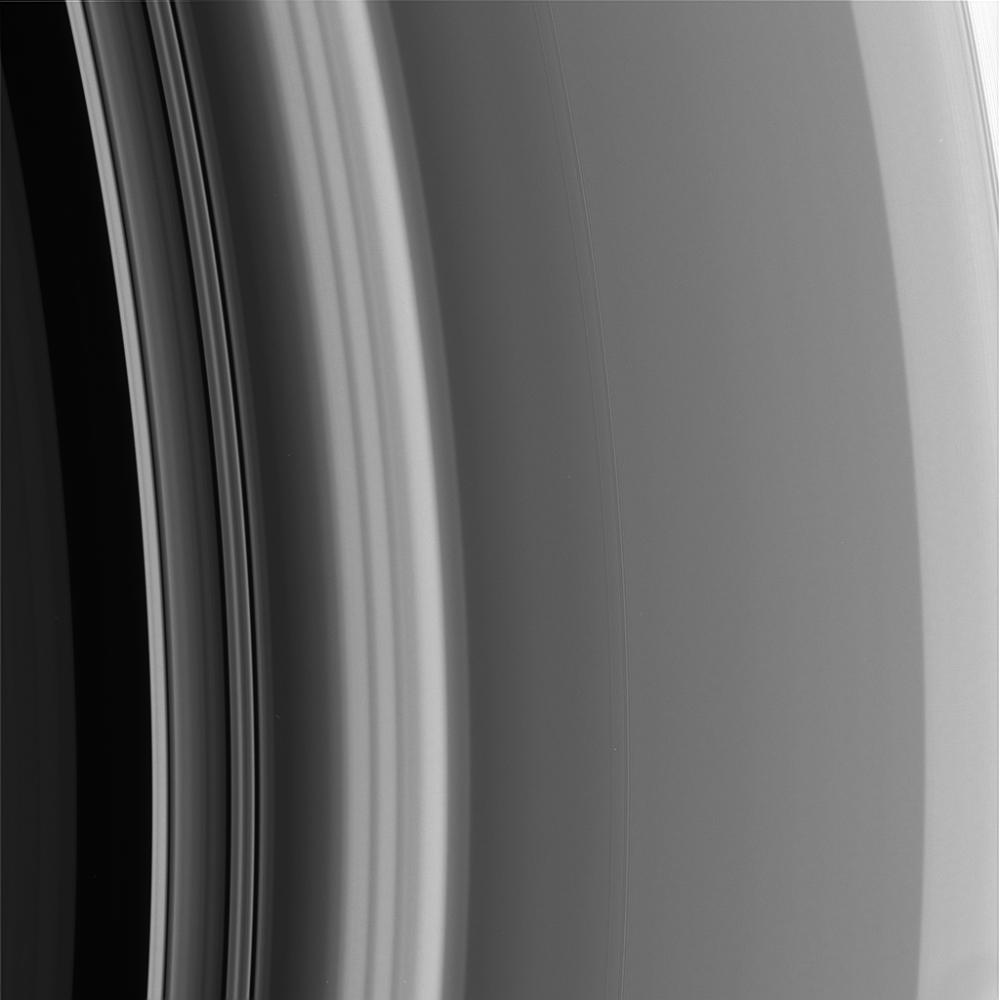
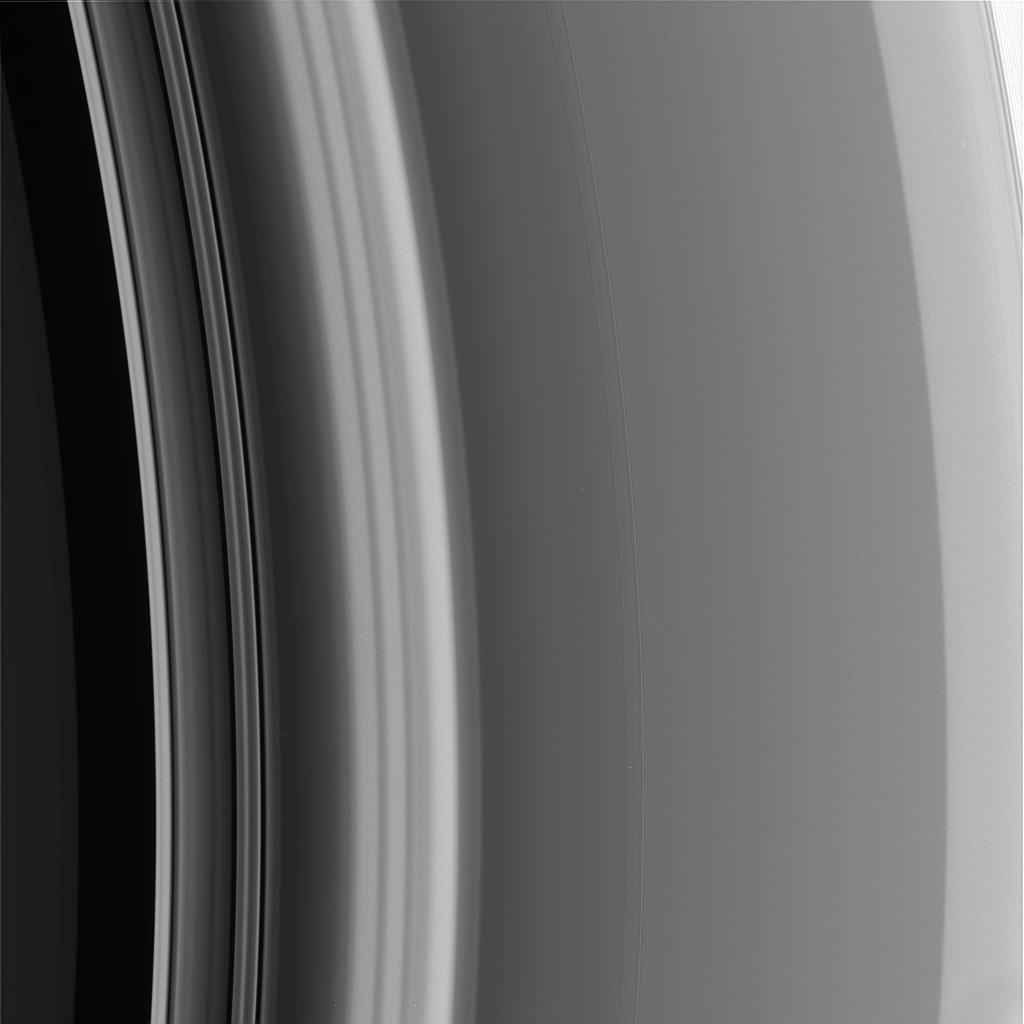
The outer reaches of Saturn's Cassini Division merges with the inner A ring (at the right) in a region that is rich in structure. For context, other Cassini views of this region are available (see PIA07512).
The smooth region leading up to the A ring grows brighter from the left to the right (known as a "ramp" to ring scientists). This region contains a faint "double-wave" structure that is a density feature caused by the influence of the co-orbital moons Janus and Epimetheus. Scientists are interested in observing the evolution of this density wave as the moons swap places in their orbits every few years, presumably resulting in a change in the perturbations that cause this feature.
This image was taken in visible light with the Cassini narrow-angle camera on Sept. 5, 2005, at a distance of approximately 441,000 kilometers (274,000 miles) from Saturn. The image scale is 2 kilometers (1 mile) per pixel.
The Cassini-Huygens mission is a cooperative project of NASA, the European Space Agency and the Italian Space Agency. The Jet Propulsion Laboratory, a division of the California Institute of Technology in Pasadena, manages the mission for NASA's Science Mission Directorate, Washington, D.C. The Cassini orbiter and its two onboard cameras were designed, developed and assembled at JPL. The imaging operations center is based at the Space Science Institute in Boulder, Colo.
For more information about the Cassini-Huygens mission visit http://saturn.jpl.nasa.gov. The Cassini imaging team homepage is at http://ciclops.org.