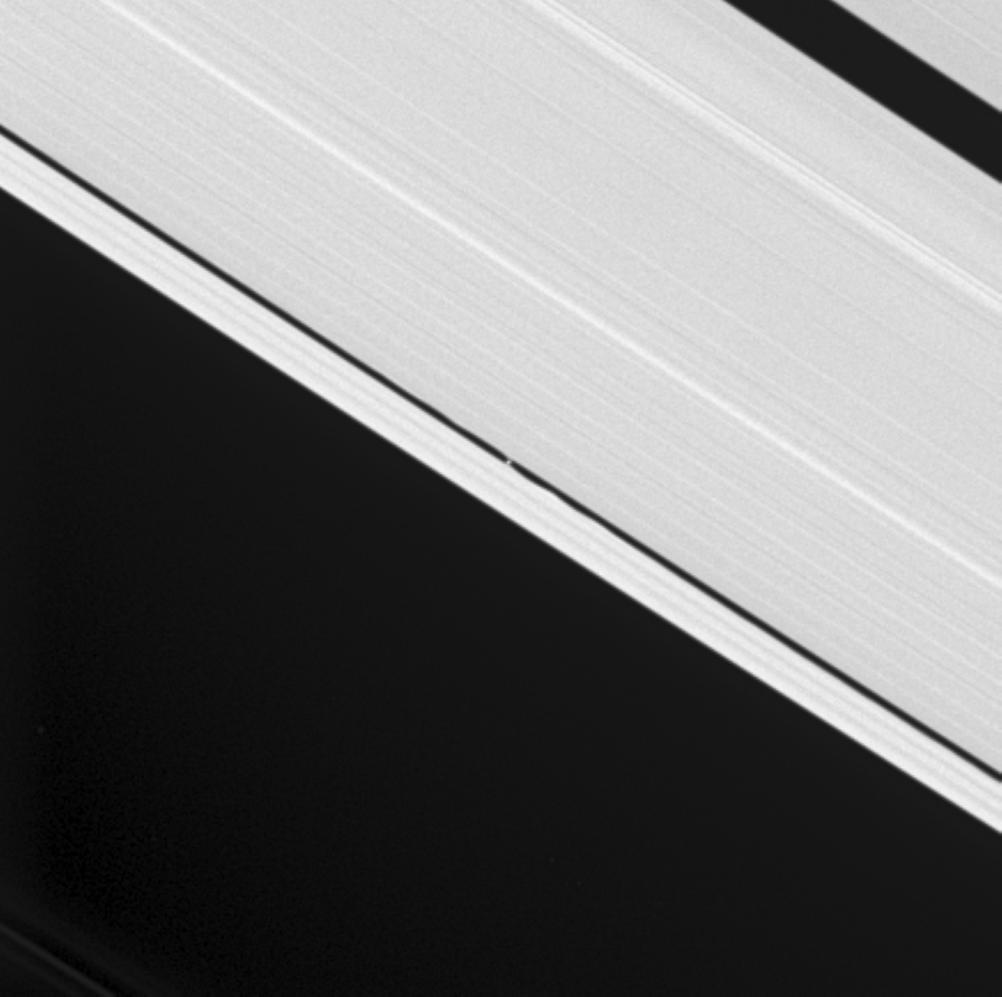
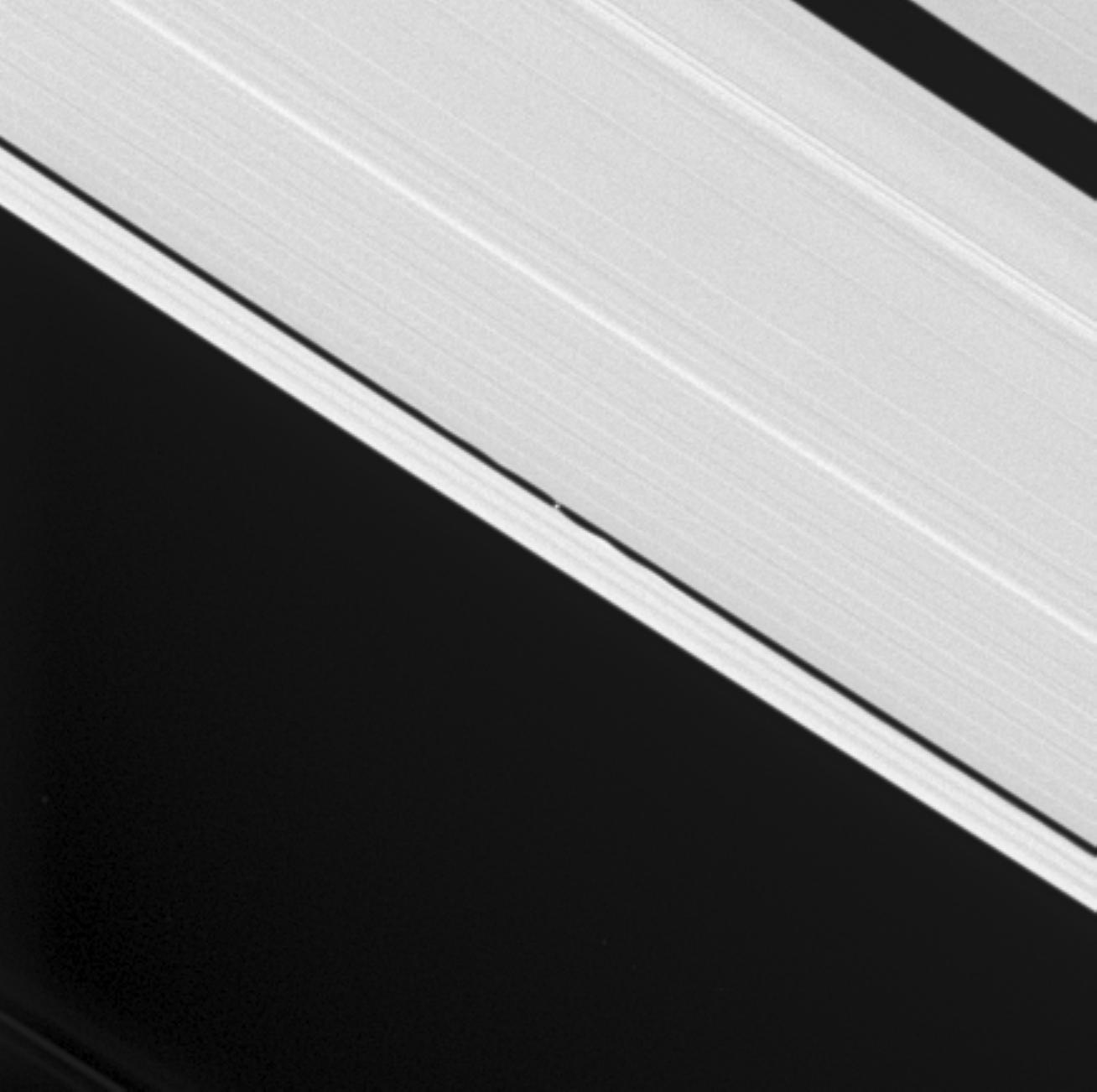
Cassini's cameras were retargeted to capture the tiny Keeler Gap moon S/2005 S1, visible at the center and first discovered by Cassini a few months ago. Waves raised in the gap edges by the Keeler moonlet's gravity are clearly visible here. Scientists can use the height of the waves to determine the little moon's mass.
The Keeler moon is 7 kilometers (4.3 miles) across and orbits within its 42-kilometer (26-mile) wide gap. The much larger Encke Gap (325 kilometers, or 200 miles wide) is seen here at the upper right, minus its embedded moonlet, Pan. Pan (26 kilometers, or 16 miles across) was discovered in images from NASA's Voyager spacecraft.
The image was taken in visible light with the Cassini spacecraft narrow-angle camera on Aug. 1, 2005, at a distance of approximately 853,000 kilometers (530,000 miles) from Saturn. The image scale is 5 kilometers (3 miles) per pixel. The image has been contrast-enhanced and magnified by a factor of three to aid visibility.
The Cassini-Huygens mission is a cooperative project of NASA, the European Space Agency and the Italian Space Agency. The Jet Propulsion Laboratory, a division of the California Institute of Technology in Pasadena, manages the mission for NASA's Science Mission Directorate, Washington, D.C. The Cassini orbiter was designed, developed and assembled at JPL.
For more information about the Cassini-Huygens mission visit http://saturn.jpl.nasa.gov. For additional images visit the Cassini imaging team homepage http://ciclops.org.