Released August 26, 2004
The THEMIS Image of the Day will be exploring the nomenclature of Mars for the next three weeks.
Gordii Dorsa
- Dorsa: ridge
- Gordii: the Gordian knot, this complex knot was tied to King Gordius of Phrygia's chariot. An oracle said that whomever untied the knot would be the next king of Asia. Alexander the Great cut open the knot with his sword.
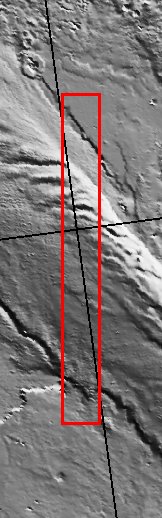
Gordii Dorsa is one of the largest ridges on Mars. The outlined area shows the margins of the dorsa on this daytime IR image. The area between the arrows is the dorsa, which rises above the surrounding plains. Gordii Dorsa is an area of intense study, as we are not yet sure how this ridge was formed. The surface of this ridge is undergoing erosion by the wind, which indicates that the material that makes up the ridge is not solid rock.
Nomenclature Fact of the Day: Some mythological accounts say that Zeus was hidden in a cave on Mt. Ida after his birth, so craters on the asteroid Ida are named for caverns and grottos all over the world.
Image information: IR instrument. Latitude 1.3, Longitude 214.6 East (145.4 West). 100 meter/pixel resolution.
Note: this THEMIS visual image has not been radiometrically nor geometrically calibrated for this preliminary release. An empirical correction has been performed to remove instrumental effects. A linear shift has been applied in the cross-track and down-track direction to approximate spacecraft and planetary motion. Fully calibrated and geometrically projected images will be released through the Planetary Data System in accordance with Project policies at a later time.
NASA's Jet Propulsion Laboratory manages the 2001 Mars Odyssey mission for NASA's Office of Space Science, Washington, D.C. The Thermal Emission Imaging System (THEMIS) was developed by Arizona State University, Tempe, in collaboration with Raytheon Santa Barbara Remote Sensing. The THEMIS investigation is led by Dr. Philip Christensen at Arizona State University. Lockheed Martin Astronautics, Denver, is the prime contractor for the Odyssey project, and developed and built the orbiter. Mission operations are conducted jointly from Lockheed Martin and from JPL, a division of the California Institute of Technology in Pasadena.



