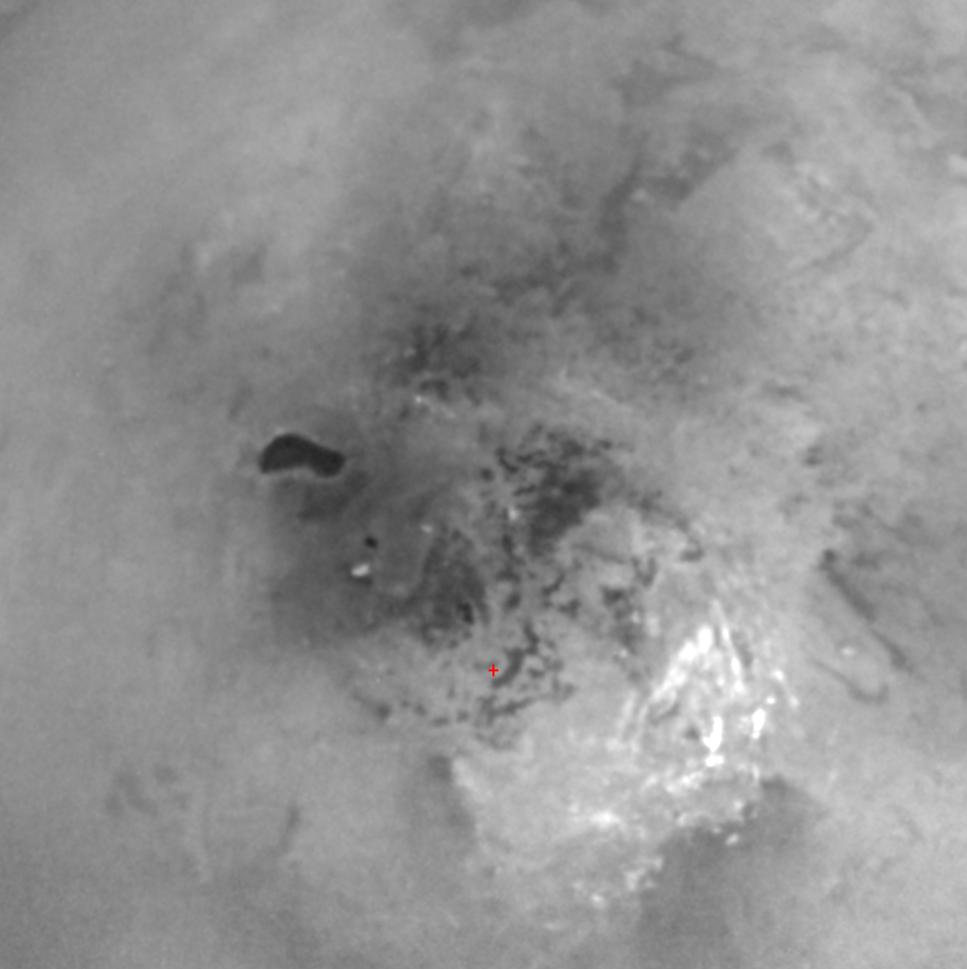
This view of Titan's south polar region reveals an intriguing dark feature that may be the site of a past or present lake of liquid hydrocarbons.
The true nature of this feature, seen here at left of center, is not yet known, but the shore-like smoothness of its perimeter and its presence in an area where frequent convective storm clouds have been observed by Cassini and Earth-based astronomers make it the best candidate thus far for an open body of liquid on Titan.
If this interpretation is correct, then other very dark but smaller features seen in the south polar region, some of which are captured in this image, may also be the sites of liquid hydrocarbon reservoirs.
In addition to the notion that the dark feature is or was a lake filled with liquid hydrocarbons, scientists have speculated about other possibilities. For instance, it is plausible that the lake is simply a broad depression filled by dark, solid hydrocarbons falling from the atmosphere onto Titan's surface. In this case, the smoothed outline might be the result of a process unrelated to rainfall, such as a sinkhole or a volcanic caldera.
A red cross below center in the scene marks the pole. The brightest features seen here are methane clouds. A movie sequence showing the evolution of bright clouds in the region during the same flyby is also available (see PIA06241).
This view is a composite of three Cassini spacecraft narrow-angle camera images, taken over several minutes during Cassini's distant flyby on June 6, 2005. The images were combined to produce a sharper view of Titan's surface. The images were taken using a combination of spectral filters sensitive to wavelengths of polarized infrared light. The images were acquired from approximately 450,000 kilometers (279,000 miles) from Titan. Resolution in the scene is approximately 3 kilometers (2 miles) per pixel. The view has been contrast-enhanced to improve the overall visibility of surface features.
The Cassini-Huygens mission is a cooperative project of NASA, the European Space Agency and the Italian Space Agency. The Jet Propulsion Laboratory, a division of the California Institute of Technology in Pasadena, manages the mission for NASA's Science Mission Directorate, Washington, D.C. The Cassini orbiter and its two onboard cameras were designed, developed and assembled at JPL. The imaging team is based at the Space Science Institute, Boulder, Colo.
For more information about the Cassini-Huygens mission visit http://saturn.jpl.nasa.gov. For additional images visit the Cassini imaging team homepage http://ciclops.org.