- Original Caption Released with Image:
-
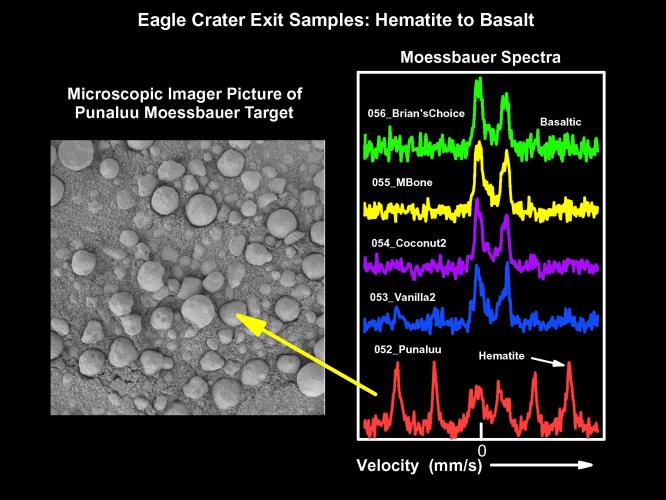
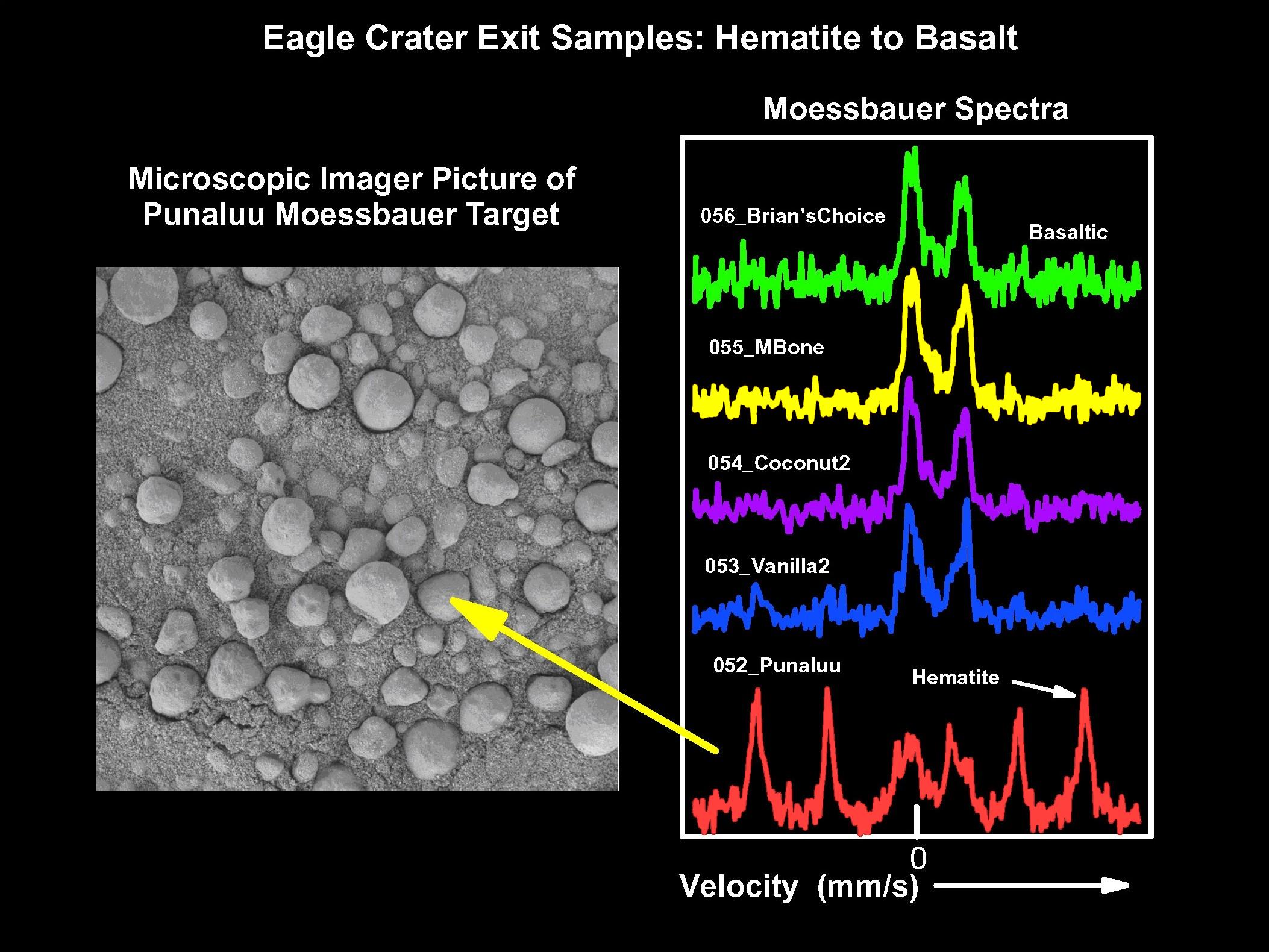
This figure shows spectra taken by the Mars Exploration Rover Opportunity's Moessbauer spectrometer at various spots in "Eagle Crater." From top to bottom, the spectra represent soil measurements taken from the center of the crater and out to the rim. The top spectrum taken on sol 56 near the center of the crater shows a basaltic mineral composition and only minor amounts of hematite. Basalts are volcanic minerals and hematite is an iron-bearing mineral often formed in water. Moving closer to the rim, the spectra show increasing amounts of hematite with the "Punaluu" site containing the highest amounts seen to date on Mars. Only minor basaltic components are seen in this sample.
The corresponding microscopic image of Punaluu shows a high density of "blueberries," indicating that these sphere-like grains are responsible for the observed high levels of hematite.
- Image Credit:
-
NASA/JPL/Cornell/USGS/University of Mainz
Image Addition Date: -
2004-03-26
|