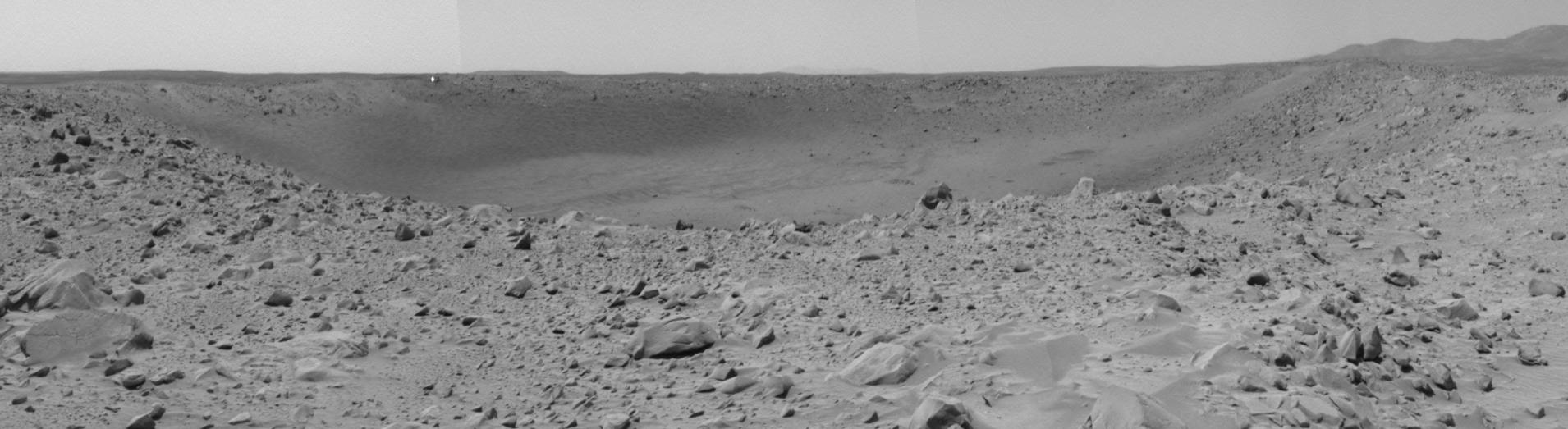
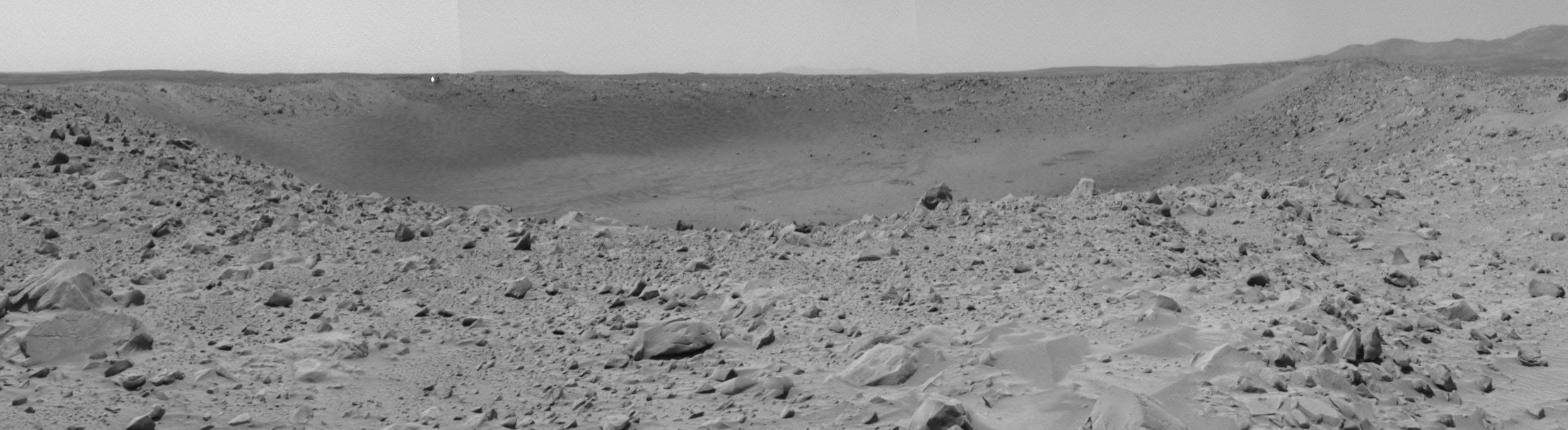
On the 66th martian day, or sol, of its mission, the Mars Exploration Rover Spirit finished a drive and sent back this navigation camera image mosaic revealing "Bonneville" crater in its entirety.
Spirit has spent more than 60 sols, two thirds of the nominal mission, en route to the rim of the large crater dubbed "Bonneville." The rover stopped on occasion to examine rocks along the way, many of which probably found their resting places after being ejected from the nearly 200-meter-diameter (656-foot) crater.
The science team sent the rover to "Bonneville" to find out more about where the rocks they have examined so far originated. Reaching the rim of this deep dish has been a major priority since day one.
According to science team member Dr. John Grant of Washington D.C.'s National Air and Space Museum, the "Bonneville" crater could be a giant window into the ancient past of the Gusev landing site. He said, "The rocks that we see scattered around our landing site may be ejecta from inside "Bonneville," but we won't know that for sure until we actually investigate the crater. We can look at the rocks' form and chemistry, but we don't know how they fit into the big picture. If we can find their occurrence within the walls of "Bonneville" crater, we'll be one step closer to understanding the processes that shaped the entire Gusev area over time."
Most scientists agree that a fitting prize for this long drive would be to find an outcrop of bedrock material that was not transported, but formed in the crater. When a meteorite slams into the ground and creates a crater, it throws surface debris out to the sides, revealing the older, mostly buried material, a sort of natural "road cut." The real gem would be to find exposed layers of the ancient rock within the "cut" walls of the crater, which would give scientists a peek into how the area formed. "The Gusev landing site is at least partially covered in a layer of ejecta material," said Grant. "As Mars was repeatedly pelted with meteorites, the ejecta kept piling on top of other ejecta leaving a blanket of debris and little trace of what the original surface was. We want to see beneath all that impact debris, into what is really filling the Gusev crater. Hopefully "Bonneville" crater will give us a clue to what the material is at the top of that pile."
 Planetary Data System