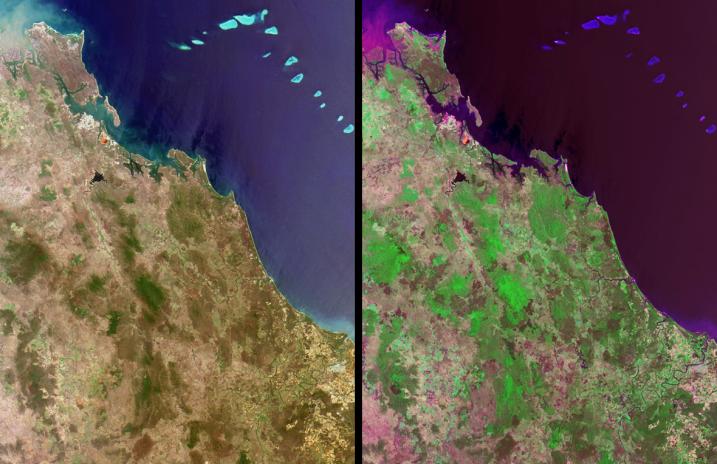
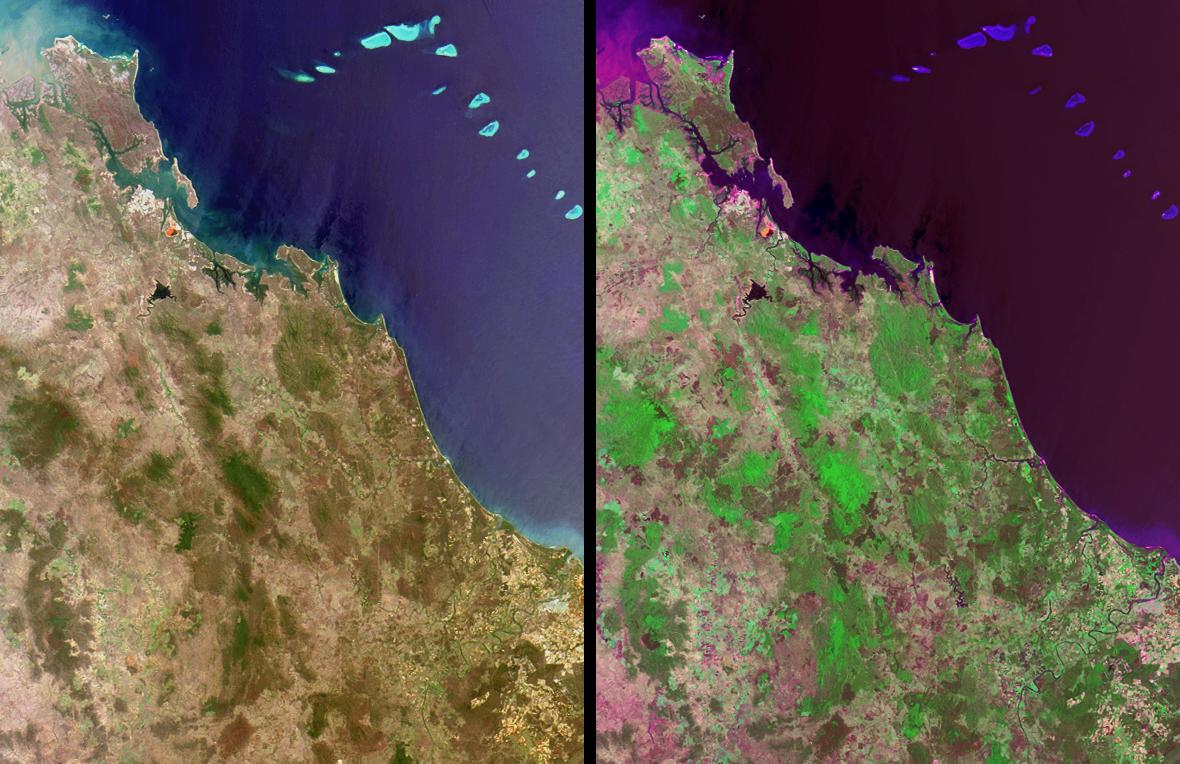
Here's another chance to play geographical detective! These images from the Multi-angle Imaging SpectroRadiometer (MISR) were captured by the instrument's nadir camera on November 19, 2001, and show a natural-color (left) and false-color (right) view of a 157 kilometer x 210 kilometer area. The natural-color image is composed of data from the camera's red, green, and blue bands. In the false-color view, the green channel has been replaced with data from the camera's near-infrared band. This emphasizes the appearance of vegetation. North is toward the top.
Use any reference materials you like to answer the following 5 questions:
1. In the upper left-hand corner, the ocean waters exhibit a murky appearance due to a large amount of sediment being discharged from a river mouth. For whom is the river named and what office did this person hold?
2. In the upper left-hand quadrant of these images, a small, bright reddish-orange feature is apparent near the coast in both the natural and false-color views. The cause of this reddish-orange feature is:
(A) The recurrence of a bloom of red algae.
(B) An abundance of naturally-occurring iron deposits.
(C) A modern art installation financed by a private consortium.
(D) Waste from a mineral manufacturing and refining process.
3. A distinctively-shaped, dark-colored reservoir with a sinewy river at one end is located to the south of the aforementioned reddish-orange feature. This reservoir is the main water supply for a nearby industrial and urban region. When these images were acquired, the water level within this reservoir was at about 45% of total capacity. Over the next six months, did the water level in the reservoir rise or fall?
4. A small seaside town within the image area (situated just over halfway down this length of coastline) was named to commemorate the year when a group of global explorers first set foot in this locality. What is the name of the town?
5. In the lower right-hand quadrant of these images, a large winding river flows through an agricultural region. Endemic only to the upper reaches of this and a few other nearby rivers is an endangered fish with a peculiar anatomical characteristic. Name the fish.
Quiz Rules
E-mail your answers, name (initials are acceptable if you prefer), and your hometown by Tuesday, October 29, to suggestions@mail-misr.jpl.nasa.gov.
Answers will be published on the MISR Quiz page in conjunction with the next weekly image release. The names and home towns of respondents who answer all questions correctly by the deadline will also be published in the order responses were received. The first 3 people on this list who are not affiliated with NASA, JPL, or MISR and who did not win a prize in the last quiz will be sent a print of the image.
A new "Where on Earth...?" mystery appears as the MISR "image of the week"approximately once every two months. A new image of the week is released every Wednesday at noon Pacific time on the MISR home page, http://www-misr.jpl.nasa.gov. The image also appears on the Earth Observatory, http://EarthObservatory.nasa.gov/, and on the Atmospheric Sciences Data Center home page, http://eosweb.larc.nasa.gov/, though usually with a several-hour delay.
MISR was built and is managed by NASA's Jet Propulsion Laboratory, Pasadena, CA, for NASA's Office of Earth Science, Washington, DC. The Terra satellite is managed by NASA's Goddard Space Flight Center, Greenbelt, MD. JPL is a division of the California Institute of Technology.