- Original Caption Released with Image:
-
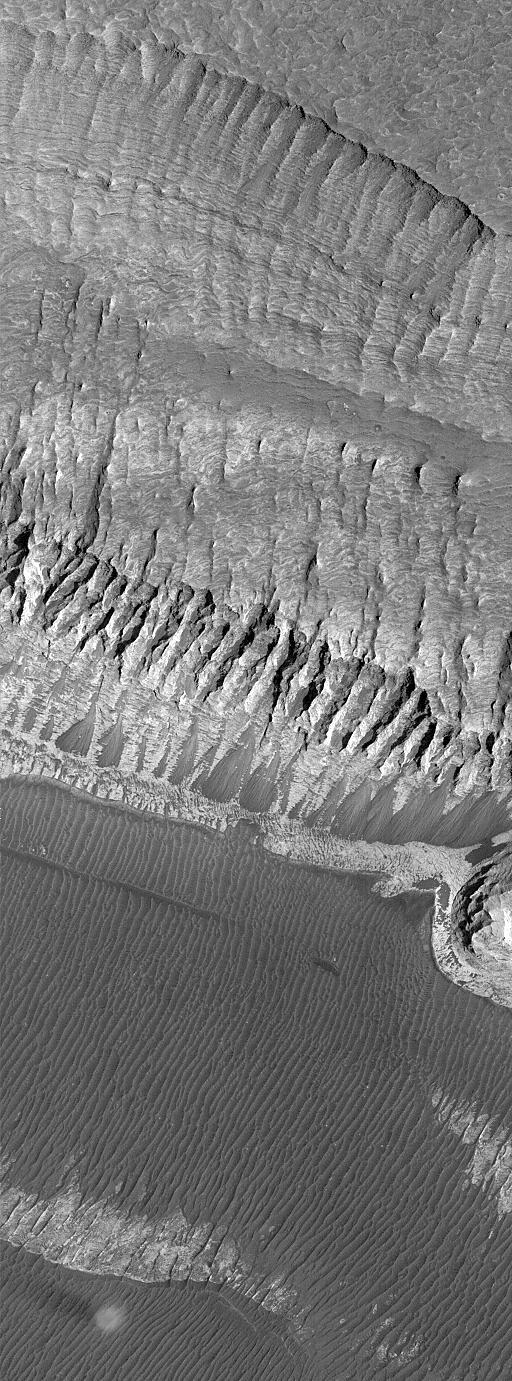
One of the earliest observations made by the Mars Global Surveyor (MGS) Mars Orbiter Camera (MOC) was that the upper crust of the planet appears to be layered to considerable depth. This was especially apparent, early in the mission, in the walls of the Valles Marineris chasms. However, layered mesas and mounds within the Valles Marineris troughs were recognized all the way back in 1972 with Mariner 9 images. The MOC image presented here shows many tens of layers of several meters (yards) thickness in the walls of a mesa in southern Melas Chasma in Valles Marineris. Erosion by mass wasting--landslides--has exposed these layers and created the dark fan-shaped deposits seen near the middle of the image. The floor of Melas Chasma is dark and covered with many parallel ridges and grooves (lower 1/3 of image). In the lower left corner of the picture, a bright, circular dust devil can be seen casting a columnar shadow toward the left. This image, illuminated by sunlight from the right/lower right, covers an area 3 kilometers (1.9 miles) wide and 8.2 kilometers (5.1 miles) long. The scene is located near 10.1°S, 74.4°W and was acquired on July 11, 1999. North is toward the lower left.
- Image Credit:
-
NASA/JPL/MSSS
Image Addition Date: -
2000-05-22
|