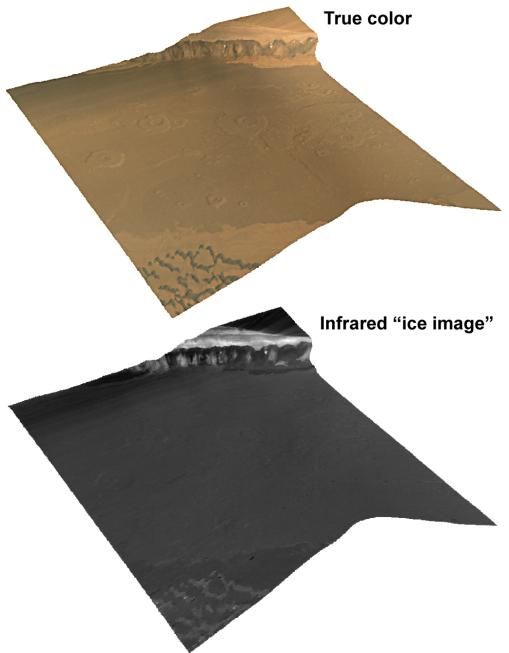
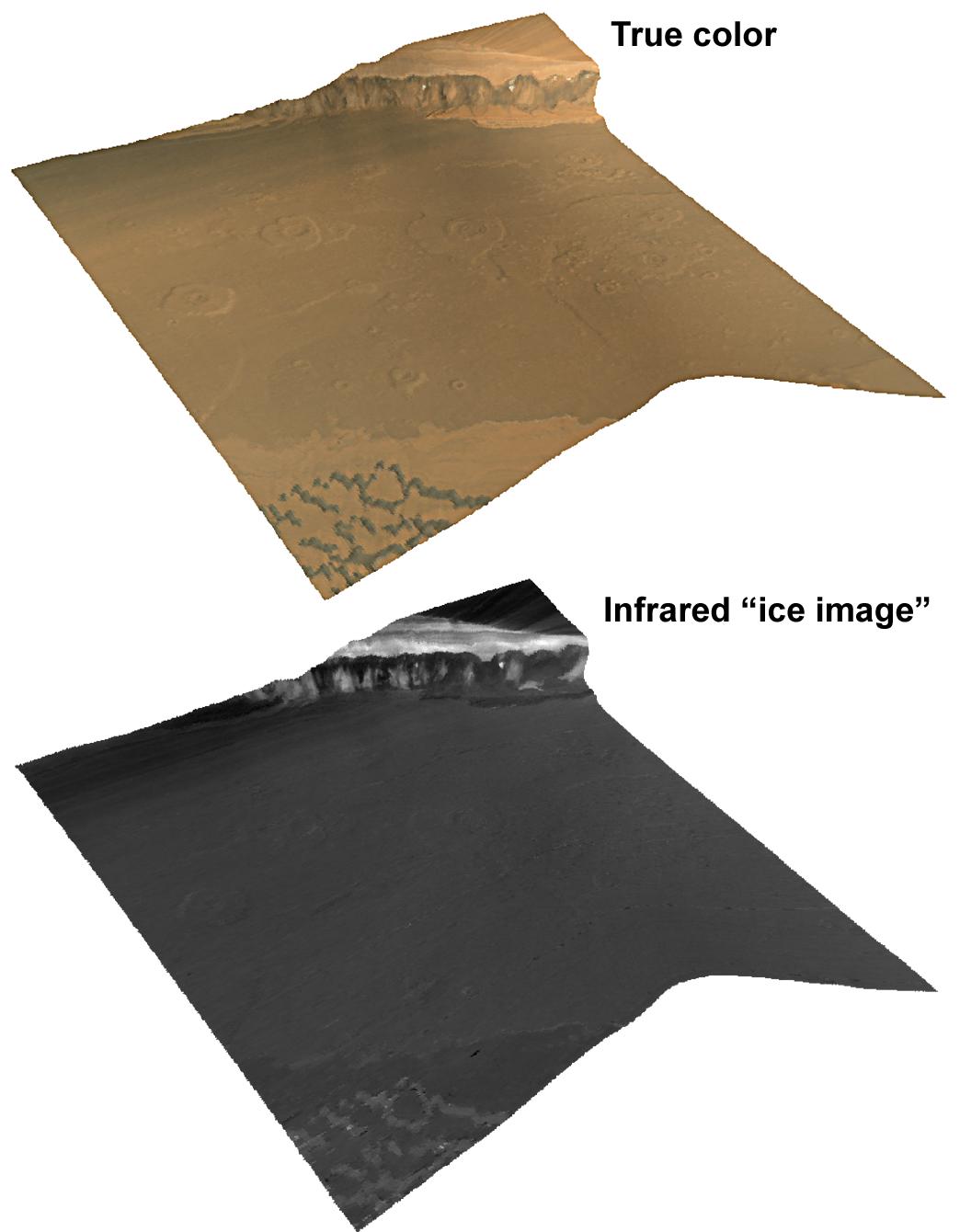
This images shows a Compact Reconnaissance Imaging Spectrometer for Mars (CRISM) full-resolution "targeted image" of the edge of Mars' north polar cap. The region in the image, Chasma Boreale, is a valley several kilometers or miles deep that cuts about 400 kilometers (about 250 miles) into the edge of the cap.
This image was acquired at 0851 UTC (4:51 a.m. EDT) on Oct. 1, 2006, near 84.6 degrees north latitude, 3.6 degrees east longitude. It covers an area about 13 kilometers (8 miles) long and, at the narrowest point, about 9 kilometers (5.6 miles) wide. At the center of the image the spatial resolution is as good as 18 meters (60 feet) per pixel. The image was taken in 544 colors covering wavelengths of 0.36 to 3.92 micrometers. Two renderings of the data are shown here, both draped over topography without vertical exaggeration, and then viewed from a perspective diagonally above the site. The top view is an approximately true-color representation. The bottom view, constructed from infrared wavelengths, shows strength of the spectral signature of ice. Brighter areas are rich in ice, and dark areas have little ice.
The polar cap has long been recognized to contain layers composed of dust and ice, and hence has been named the polar layered deposit. This sits atop an underlying "basal unit." The upper part of the basal unit is dark at visible wavelengths and steeply sloped, whereas the lower part of the basal unit is brighter, redder, and layered like the polar layered deposits. The chasma floor is cratered, and in the foreground it is covered by dunes that are outliers of a north polar sand sea that surrounds the polar cap. The polar layered deposits and the basal unit form a steeply sloping scarp about 1.1 kilometers (0.7 miles) high.
CRISM's image of this region shows a number of previously unrecognized characteristics of the polar layered deposits and the basal unit. First, the ice-rich polar layered deposits exhibit coherent banding both at visible and infrared wavelengths. This banding shows a history of differences in the abundance of dust that accumulated in polar ice, differences in ice grain size, or both. Second, both parts of the basal unit are depleted in ice, except for triangle-shaped regions on the side of the scarp. Third, the spectral properties of the brighter, layered lower basal unit resemble those of the polar layered deposits. In contrast, the upper basal unit is distinct from both of them. Finally, spectral properties of the foreground dunes closely resemble those of the darkest layers within the upper basal unit, and may be debris from it.
CRISM is one of six science instruments on NASA's Mars Reconnaissance Orbiter. Led by The Johns Hopkins University Applied Physics Laboratory, the CRISM team includes expertise from universities, government agencies and small businesses in the United States and abroad.
CRISM's mission: Find the spectral fingerprints of aqueous and hydrothermal deposits and map the geology, composition and stratigraphy of surface features. The instrument will also watch the seasonal variations in Martian dust and ice aerosols, and water content in surface materials -- leading to new understanding of the climate.
NASA's Jet Propulsion Laboratory, a division of the California Institute of Technology, Pasadena, manages the Mars Reconnaissance Orbiter mission for the NASA Science Mission Directorate. Lockheed Martin Space Systems, Denver, is the prime contractor and built the spacecraft.